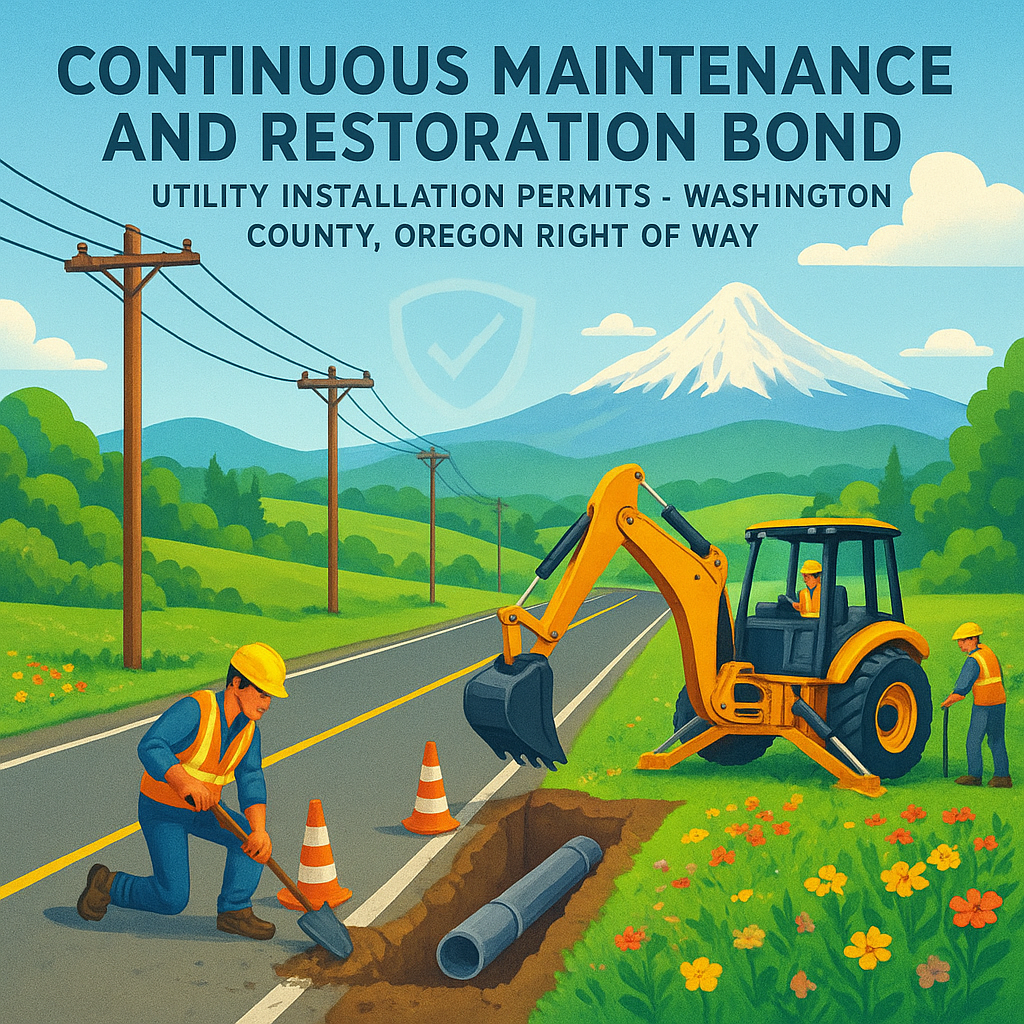
Have you ever wondered what happens after a utility company digs up a freshly paved road to install new water lines or fiber optic cables? Those trenches, patched asphalt, and disturbed sidewalks don’t magically fix themselves. In Washington County, Oregon, there’s a quiet safeguard that ensures our streets and public spaces are restored to their original condition—and kept that way. It’s called a Continuous Maintenance and Restoration Bond, and if you’re planning a utility installation project in the right-of-way, you’ll need to understand how it works. Let’s walk through this together, in plain language, so you can navigate the permit process with confidence.
What Is a Continuous Maintenance and Restoration Bond?
At its heart, this bond is a financial promise. Think of it as a security deposit that doesn’t tie up your cash but still holds you accountable. When you obtain a permit to install utilities—like gas, electric, water, sewer, or telecommunications lines—within Washington County’s public right-of-way, you’re required to post this bond. It guarantees that once the work is done, you’ll restore the area properly and continue to maintain that restoration for a set period. If something goes wrong, like a sunken trench or crumbling asphalt two years later, the county can use the bond funds to fix it without chasing you down.
Why Washington County Requires This Bond
Local governments walk a fine line between encouraging utility upgrades and protecting taxpayer-funded infrastructure. Roads, sidewalks, and landscaping represent millions of dollars in public investment. A poorly compacted trench can turn into a pothole hazard, a tripping risk, or a drainage nightmare. Washington County’s requirement for a continuous maintenance bond isn’t just bureaucratic red tape. It’s a practical tool to shift the financial risk from the community back to the party doing the work. It ensures that the contractor or utility company—not the county or residents—pays to make things right if a restoration fails over time.
Who Needs One of These Bonds?
If your project involves cutting, excavating, or boring beneath any public right-of-way in Washington County, you’ll likely be asked for this bond. This includes:
- Telecom and cable companies laying fiber optic networks.
- Plumbers connecting new developments to water and sewer mains.
- Electrical contractors burying power lines.
- Municipal utility crews performing maintenance or extensions.
- Developers putting in new streets and utility connections for subdivisions.
Even if you’re a subcontractor digging the trench while a larger company holds the permit, the bond is usually required for the permit holder. So before you break ground, check with the county’s engineering or public works department to confirm your specific bonding needs.
How the Bond Works: A Three-Party Safety Net
Like many surety bonds, this one involves three players:
- The Principal: That’s you—the contractor or utility company obligated to do the work and restore the area.
- The Obligee: Washington County, which requires the bond to protect public property and residents.
- The Surety: The bonding company that backs your promise financially. If you fail to restore or maintain the site, the surety pays the county up to the bond limit, then you reimburse the surety.
Picture it like a rental car insurance policy. You’re responsible for any dents, but the insurance covers the car owner if you can’t pay. Here, the county is the car owner. The bond guarantees they won’t bear the cost of your “dents” in the pavement.
The “Continuous Maintenance” Part Explained
Unlike a simpler restoration bond that only covers the initial repair, a continuous maintenance bond keeps the guarantee alive for a multi-year term after the project is completed. In Washington County, this period might be two, three, or even five years depending on the scope of work. During this time, you’re responsible for any settlement, cracking, potholes, or vegetation failures within the right-of-way that resulted from your excavation. If a water main you installed shifts and causes a dip in the road 18 months later, the bond steps in. This long tail of accountability encourages contractors to get the job done right the first time, using proper compaction methods and materials.
The Restoration Process and How Inspections Tie In
Once your utility is installed, you can’t just throw some asphalt over the trench and call it a day. Washington County sets strict standards for trench repair, often requiring a temporary patch followed by a permanent restoration months later to allow for settling. Officials will inspect the site at various stages. If the work passes, great. If not, you’ll receive a notice to fix deficiencies. Ignore it, and the county can file a claim against your bond. For you, that means your surety will either make you pay for the repairs or hire someone to finish them—and your bonding relationship might suffer. So it’s in your best interest to stay on top of the restoration timeline and communicate openly with county inspectors.
How to Get a Continuous Maintenance Bond in Washington County
Obtaining this bond is straightforward, especially if you work with a specialized surety bond agency. Here’s a typical path:
- Confirm the bond amount. The county will tell you the required coverage, often based on the linear feet of excavation or a flat minimum like $10,000 or $50,000.
- Apply with a surety company. You’ll provide basic business and financial information. The surety evaluates your credit, experience, and financial stability to determine the premium.
- Pay the premium. This is a small percentage of the total bond amount—commonly 1% to 5% for well-qualified applicants. So a $20,000 bond might cost you $200 to $1,000 a year, not $20,000 upfront.
- File the bond with the county. The surety will issue the bond form, which you or your agent send to Washington County as part of your permit application.
What Determines the Cost of Your Bond?
Bond premiums aren’t one-size-fits-all. A few factors play a role:
- Personal and business credit history. Higher credit scores typically unlock lower rates.
- Length of time in business and past project experience. Experienced contractors are seen as lower risk.
- The required bond amount. Larger bonds mean higher total premiums, though the rate may stay similar.
- Whether you need a separate maintenance period or a combined work and maintenance bond. Some agencies bundle the bond with a performance bond for the construction phase.
Even if your credit isn’t perfect, many surety companies offer programs that can still get you bonded, sometimes with a slightly higher rate. It’s worth shopping around.
Avoid These Common Pitfalls
Working in the right-of-way can get complicated fast. Here are a few missteps I’ve seen that you’ll want to dodge:
- Forgetting to renew the bond. The continuous maintenance period often requires yearly bond renewals until the obligation is released. A lapse can halt your permit or trigger a claim.
- Misunderstanding the maintenance term. Don’t assume you’re off the hook after a single winter. Read the county’s written policy so you know exactly when your responsibility ends.
- Skipping the pre-construction meeting. Meeting with county inspectors beforehand can clarify expectations and documentation, saving you costly rework later.
- Using the wrong fill material. Improper trench backfill is the number one cause of future settlement claims. Follow the county’s specifications to the letter.
Real-World Analogy: This Bond as a Gardening Guarantee
Imagine a landscaper plants a young tree in your front yard, right in the middle of a public pathway strip. The city requires a bond in case the tree dies or damages the sidewalk in the next three years. That’s exactly how the continuous maintenance bond works for utility cuts. The community gets the benefit of the new utility service, but the company that created the disruption must ensure the public space remains safe and well-maintained for years to come. It’s a fair trade that keeps neighborhoods looking good and streets hazard-free.
What Happens When the Maintenance Period Ends?
Once the agreed-upon term elapses and all final inspections pass, you can request a release of the bond. Washington County will typically perform a walk-through and, if everything is satisfactory, close out the permit and exonerate the bond. You’ll then stop paying renewal premiums and the surety’s obligation ends. It’s a satisfying end to a long-term commitment. Many contractors mark their calendars and make that final inspection request as soon as the window opens to wrap things up efficiently.
How This Bond Benefits Everyone
It’s easy to see the bond as just another hoop to jump through, but it really serves the bigger picture. For the county and taxpayers, it preserves infrastructure integrity without dipping into public funds. For contractors, it can be a mark of professionalism and reliability—when you’re bonded, you signal that you stand behind your work. For residents, it means fewer pothole-dodging commutes and a safer walking environment. When you step back, this little piece of paper does a lot of heavy lifting to keep our shared spaces in top shape.
Getting Started with Your Utility Installation Permit
Ready to take the next step? Start by reaching out to Washington County’s Department of Land Use and Transportation or Public Works. They’ll give you the exact bond form and amount you’ll need. Then, partner with a reputable surety bond agency that understands Oregon’s municipal requirements. They can walk you through the application, answer your credit questions, and get you bonded quickly. In the time it takes to gather your business documents, you could be on your way to an approved bond and a clear path to breaking ground.
Utility work doesn’t have to be a headache for you or the community. With a continuous maintenance and restoration bond in place, you’re not just meeting a regulatory checkbox—you’re building trust and keeping Washington County’s public right-of-way safe, beautiful, and fully functional for years to come.
Leave a Reply