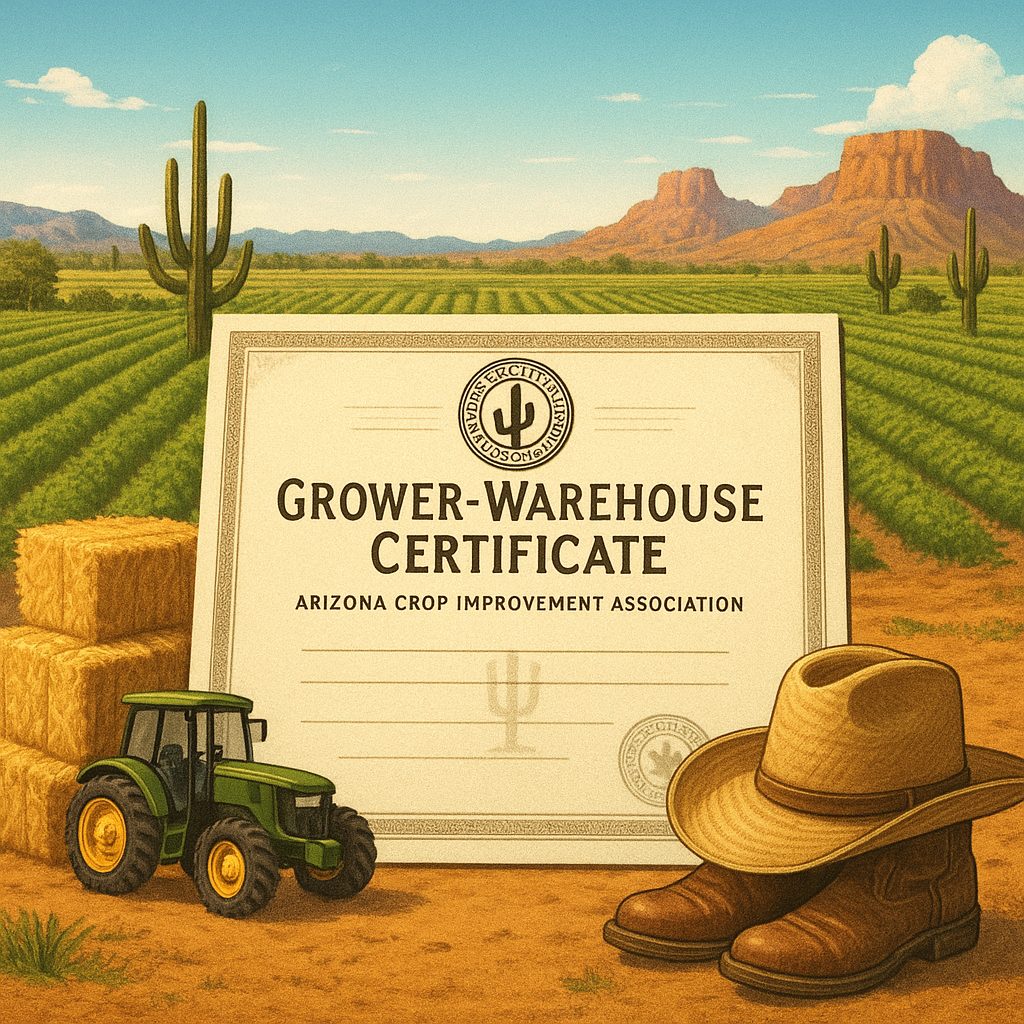
If you’re involved in Arizona’s agricultural world—whether you’re a grower, a warehouse operator, or even a hay broker—you might have heard whispers about something called the Grower-Warehouse Certificate. It sounds official, maybe a little intimidating, but it’s actually a tool designed to make life easier and more trustworthy for everyone handling crops. Let’s pull back the curtain on what this certificate is, why it requires a bond, and how the Arizona Crop Improvement Association fits into the big picture.
So, What Exactly Is a Grower-Warehouse Certificate?
Think of the Grower-Warehouse Certificate as a kind of passport for crops. It’s a document issued under the watchful eye of the Arizona Crop Improvement Association that verifies the identity, quality, and handling history of agricultural products—especially seeds and grains—as they move from the field to a warehouse, and eventually to buyers. In a state where agriculture is a multi-billion-dollar industry, this little piece of paper carries a lot of weight.
More than just a receipt, it’s a promise. When a grower stores their harvest in a licensed warehouse, the certificate records crucial details: the type of crop, the quantity, the class or variety, and sometimes even germination rates or purity levels if it’s seed. This keeps everyone honest. Without it, crop management could quickly turn into a guessing game.
Where Does the Bond Come Into Play?
Now you might be wondering, “Why did I see the word ‘bond’ attached to this?” Great question. In many cases, warehouse operators and hay brokers who handle these certificates are required to secure a Grower-Warehouse Certificate Bond. This isn’t just a formality; it’s a financial safety net.
Imagine you’re a farmer who deposits 5,000 bushels of barley at a local storage facility. You receive a Grower-Warehouse Certificate as proof. If the warehouse were to misplace the barley, sell it without authorization, or go out of business, that certificate alone wouldn’t put money back in your pocket. The bond steps in to cover valid claims, up to a set amount. It’s essentially a guarantee that the warehouse will play by the rules—and if they don’t, there’s a fund to make things right.
For hay brokers, a similar principle applies. A hay broker’s bond tied to the Grower-Warehouse Certificate program protects growers and buyers from financial harm if the broker fails to pay for hay they’ve received, or doesn’t deliver what has already been paid for. It builds a bridge of trust, ensuring that crop management doesn’t collapse under the weight of a bad deal.
The Arizona Crop Improvement Association: The Backbone of the System
The Arizona Crop Improvement Association (ACIA) might not be a household name, but for seed growers, warehouse managers, and brokers, it’s a cornerstone organization. They oversee the Grower-Warehouse Certificate program, providing the official forms, setting standards, and often working hand-in-hand with the Arizona Department of Agriculture. Their goal is straightforward: enhance the quality and marketability of Arizona crops through certification, education, and traceability.
When you fill out a certificate on an ACIA-approved form, you’re plugging into a system that’s been refined over decades. Seed producers rely on this to distinguish their high-germination alfalfa or certified cotton seed from a generic commodity. Buyers, whether local dairies or overseas customers, look for that ACIA stamp as a sign of reliability.
How Does This Fit Into Everyday Crop Management?
Let’s bring this down to earth with a practical scenario. Say you run a mid-sized farm in Pinal County, growing durum wheat. After harvest, you truck the grain to a commercial warehouse. The warehouse operator inspects the load, weighs it, and issues a Grower-Warehouse Certificate on the spot. That document tells you exactly how much wheat you put in, its moisture level, and perhaps its protein content if it was tested.
Now, from a crop management perspective, you have a clear record. You can compare this year’s yield and quality against previous years. If you decide to sell the wheat two months later when prices improve, you simply transfer the certificate to the buyer—no need to physically move the grain until much later. This saves time, fuel, and stress. Even better, if you’re working with a lender who used your stored crop as collateral, they’ll likely want to see that certificate too. It’s proof that the asset really exists.
Why Hay Brokers Can’t Ignore This
Hay brokers operate in a fast-moving world. They often coordinate between multiple growers and dairies or export markets. With the Grower-Warehouse Certificate system, a broker can secure large volumes of hay that are already certified for quality and weight. This speeds up transactions and reduces the need for repeated testing. But here’s the catch: the State of Arizona expects brokers who handle these certificates to maintain a bond. Skipping this requirement can lead to license suspension, fines, or even legal action. So, for a hay broker, the certificate isn’t just a convenience—it’s a regulated tool that, when coupled with the right bond, builds a solid reputation.
What does that look like in real life? Let’s say a broker contracts with a dairy to supply 200 tons of premium alfalfa hay each month. The hay is stored in a bonded warehouse and covered by a Grower-Warehouse Certificate. The dairy can breathe easy knowing that the hay won’t mysteriously disappear, and if a dispute arises over payment or quality, there’s a clear paper trail—plus the bond to fall back on.
Skipping the Jargon: A Simple Breakdown
We’ve tossed around terms like “bonded warehouse” and “certificate form.” Let’s clarify them in plain English:
- Grower-Warehouse Certificate (ACIA form): A special document that records what crop you stored and its key characteristics. Think of it as a combination receipt and quality report.
- Arizona Crop Improvement Association: The organization that provides the official forms and sets the rules for how those certificates are used in the state.
- Bond: A sum of money set aside (often via an insurance company) to protect farmers and buyers if the warehouse or broker does something wrong.
- Hay Broker Bond: Specifically for individuals brokering hay deals—this bond adds a layer of protection when certificates change hands.
- State of Arizona: Sets the legal requirements, including who needs a license and a bond to handle these certificates.
This might feel like a lot of paperwork, but when you compare it to the chaos of verbal agreements and unverified storage, it’s a no-brainer. The certificate system turns a warehouse receipt into a trusted, tradable, and trackable asset.
Who Needs to Pay Attention to This?
Does this apply to you? If you wear any of these hats, the answer is a resounding yes:
- Growers who store their harvest off-farm before sale.
- Warehouse operators who hold agricultural products for others.
- Hay brokers who buy, sell, or arrange transportation of hay in Arizona.
- Seed producers who want their product to carry the Arizona Crop Improvement Association’s mark of quality.
- Lenders who accept stored crops as collateral and need verifiable proof.
Even if you’re just starting out as a small-scale organic farmer who occasionally stores grain with a neighbor, understanding this system can help you protect your investment. You might not be required to post a bond yourself, but knowing that your warehouse has one adds peace of mind.
Common Questions That Pop Up
“Is the Grower-Warehouse Certificate the same as a regular warehouse receipt?” Not exactly. A regular receipt might just show the quantity. The ACIA certificate goes further by often including grade, variety, and quality analysis—especially for seeds. It’s tailor-made for Arizona’s crop improvement standards.
“How do I get a bond?” Most insurance agencies that specialize in agricultural bonds can help. The bond amount varies based on the volume of crops you handle and the specific license you hold. Working with a knowledgeable surety bond professional can make the process smooth and affordable.
“What happens if a bonded warehouse goes bankrupt?” The bond kicks in to cover the value of the stored crops, up to the bond’s limit. Farmers who hold certificates can file a claim and typically receive compensation. Without the certificate, proving ownership and quantity would be a real uphill battle.
Making Crop Management Smarter, Not Harder
In the end, the Arizona Grower-Warehouse Certificate isn’t about red tape for the sake of red tape. It’s a tool that brings transparency to crop handling, and when paired with the required bonds, it paints a picture of reliability that benefits everyone from the field to the feed trough. When you can trace a bale of hay or a bin of wheat back to its origin with a few pieces of paper, you’re practicing better crop management—the kind that reduces waste, prevents disputes, and opens doors to premium markets.
So, next time you hear a fellow farmer or broker mention “the ACIA form,” you’ll know it’s much more than a piece of paper. It’s a building block for a stronger, fairer agricultural community in Arizona. And who doesn’t want that?
Leave a Reply