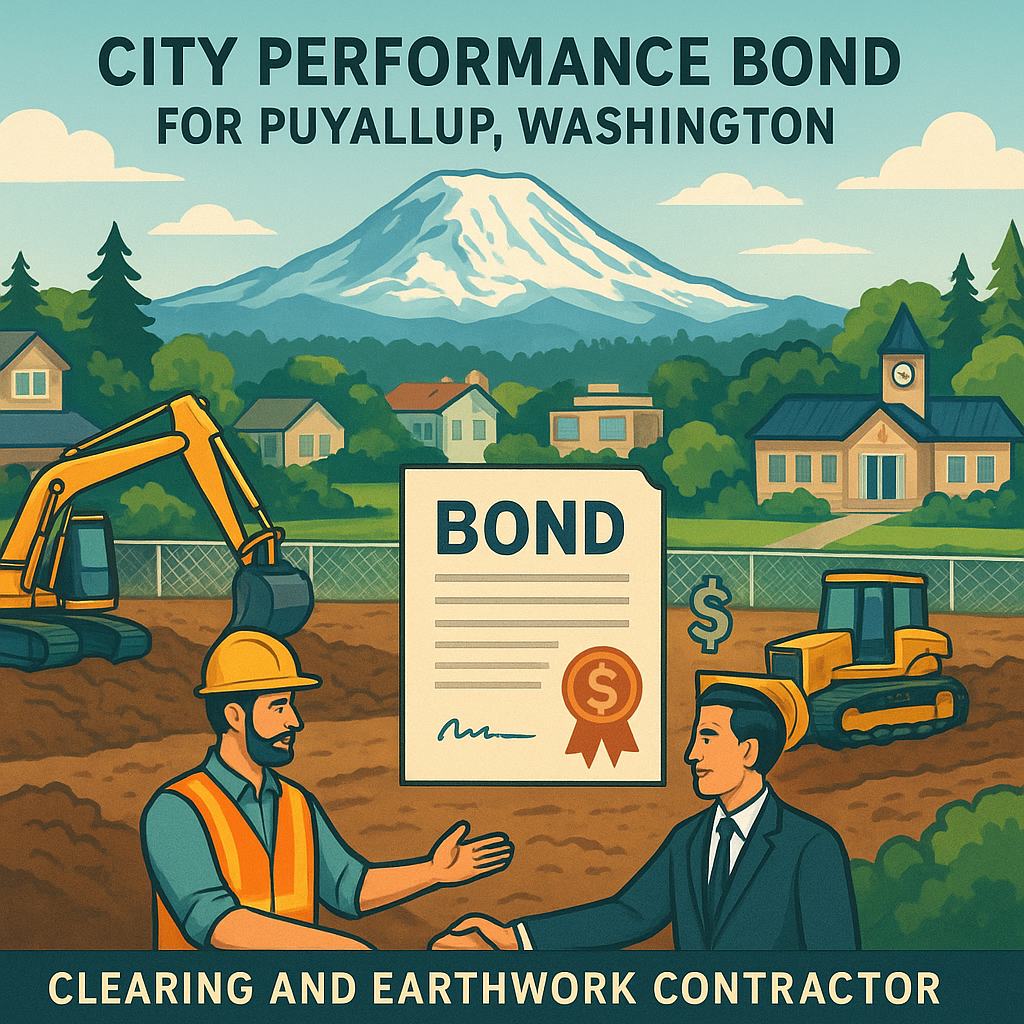
If you’re a clearing and earthwork contractor in the City of Puyallup, Washington, you’ve probably heard the term “performance bond” tossed around. It can sound intimidating — like a secret handshake only big construction companies know. But here’s the truth: it’s simply a promise, backed by money, that you’ll do the job you said you’d do. And in Puyallup, that promise runs directly to the municipality.
Whether you’re grading a lot, clearing land for a new subdivision, or stabilizing a slope after a rainy winter, the city wants to know the work will be done right. That’s where the Puyallup City Earthwork Contractor Bond comes in. Let’s break it all down in plain English — no legal headaches, no fine print that makes your eyes glaze over.
What Exactly Is a Puyallup City Performance Bond?
Think of a performance bond as a safety net. You’re not buying insurance for yourself — you’re buying a guarantee for the city that your earthwork project will be finished according to the approved plans and local codes. If something goes wrong — maybe your company runs into financial trouble, or the work is left incomplete — the bond steps in to cover the cost of fixing it.
In Puyallup, this bond “runs to the municipality.” That means the City of Puyallup is the protected party. They hold the bond. They can make a claim against it if you fail to meet your obligations. It’s a three-party agreement: you (the contractor), the city (the obligee), and the surety company (the one backing the bond).
It’s similar to renting an apartment and putting down a security deposit. The landlord holds that deposit in case you damage the unit. Here, the city holds your bond — not to punish you, but to make sure the community’s land and infrastructure aren’t left in a lurch.
Why Does the City of Puyallup Require This Bond?
Imagine a contractor starts clearing a hillside for a new housing development. They cut into the slope, but halfway through the job, they disappear. The erosion control measures aren’t finished. Rain washes mud into the streets, clogs storm drains, and destabilizes the neighbor’s property. Now it’s the city — and ultimately the taxpayers — who have to scramble to fix the mess.
Puyallup has seen enough wet winters and muddy springs to know that incomplete earthwork can lead to serious environmental and safety problems. Requiring a performance bond is the city’s proactive way of protecting itself and its residents. It ensures:
- The work complies with grading, drainage, and erosion control standards.
- Public infrastructure like roads and sidewalks stays safe.
- Neighboring properties aren’t damaged by runoff or unstable soil.
- The project gets finished, not abandoned.
For you, the contractor, having that bond in place also signals professionalism. It tells the city, “We’re serious, we’re vetted, and we stand by our work.” It can even give you a competitive edge when bidding on projects.
Who Needs a Clearing and Earthwork Contractor Bond in Puyallup?
Not every small landscaping job requires a bond. But if your work triggers a grading permit, a right-of-way permit, or involves significant soil disturbance, the city will likely ask for one. Common projects include:
- Mass grading for commercial or residential developments.
- Clearing and grubbing to prepare a site for construction.
- Excavation and fill operations that change the topography.
- Stormwater management facilities and retention ponds.
- Streambank stabilization or erosion repair work.
The bond amount is typically set by the city based on the project’s scope. You might see a bond that equals 100% to 150% of the estimated cost of the required improvements. Why? Because if things go south, the city needs enough financial backup to hire another contractor and get the job done without dipping into public funds.
How Does the Bond Process Work from Start to Finish?
Let’s walk through it step by step. You might be surprised how straightforward it is once you know the roadmap.
1. The City Determines Bond Requirements
After you submit your plans and permit application, Puyallup’s engineering or planning department reviews the project. They’ll tell you the required bond amount and the specific obligations you must meet (for example, final grading, erosion control, sidewalk repair).
2. You Apply for the Bond
You reach out to a surety bond company or an agency that specializes in contractor bonds. You’ll fill out an application that asks about your business finances, experience, and credit history. The surety wants to know: “Are you capable of finishing this project, and do you have a track record of doing so?”
3. Underwriting and Approval
The surety company evaluates your application. If your financials are solid and you have good credit, approval is usually quick — sometimes the same day. If your credit isn’t perfect, you might still get approved but pay a higher premium. We’ll talk about costs in a moment.
4. You Pay the Premium and Receive the Bond
Once approved, you pay a percentage of the total bond amount (the premium). The surety then issues the bond paperwork. You file this with the City of Puyallup as part of your permit package.
5. Project Completion and Bond Release
You do the work. The city inspects it. When everything meets the standards, the city releases the bond — often backdated or formally closed out. You don’t get the premium back (that’s the cost of the guarantee), but the bond obligation is lifted.
What Happens If Something Goes Wrong?
Nobody likes to dwell on worst-case scenarios, but it’s important to understand the stakes. If the city determines you haven’t fulfilled your obligations — say, the site grading is incomplete and erosion is damaging a creek — they can file a claim against your bond. Here’s the typical sequence:
- The city notifies you and the surety of the deficiency, often giving you a chance to fix it.
- If the problem isn’t resolved, the surety investigates. They may hire another contractor to finish the work, or they may pay the city the bond amount up to the bond’s limit.
- Here’s a crucial point: the bond is not insurance for you. The surety will then seek reimbursement from you for every penny they paid out. That means you could be personally on the hook for the full bond amount, plus legal costs.
So while the bond protects the city, it also keeps you incredibly accountable. It’s a strong motivator to do the job right the first time.
How Much Does a Puyallup Earthwork Contractor Bond Cost?
You won’t pay the full bond amount upfront. You pay a premium, which is a small percentage of the total bond value. For most contractors with good credit, that premium ranges from 1% to 3% of the bond amount. So if the city requires a $50,000 performance bond, your premium might be $500 to $1,500 for a one-year term.
Several factors influence your rate:
- Credit score: Higher scores get lower rates. Simple as that.
- Business financials: The surety looks at your company’s balance sheet, cash flow, and profitability.
- Experience and license history: A clean track record in Puyallup and other Washington cities works in your favor.
- Bond amount: Larger bonds may require more underwriting scrutiny, but the percentage rate often stays in the same ballpark.
If your credit is less than perfect, don’t panic. There are surety companies that specialize in bonding contractors with challenges. You might pay a higher rate — maybe 4% or 5% — but you can still get bonded. Many contractors start there, build their business, and graduate to better rates over time.
Can You Get Bonded Fast?
Absolutely. If you have your documents in order — business license, contractor’s registration, financial statements — many agencies can turn around a bond within 24 to 48 hours. Some even offer instant online quotes for smaller bond amounts. The key is being prepared and knowing which information the city requires on the bond form (like the exact project name, permit number, and obligee name being “City of Puyallup”).
What’s the Difference Between a Performance Bond and a Maintenance Bond?
Sometimes Puyallup will also ask for a maintenance bond after the work is done and the performance bond is released. This is a separate promise that you’ll fix any defects in materials or workmanship for a specified period — often one or two years. Think of the performance bond as the “build it right” promise and the maintenance bond as the “keep it right” promise. Your bonding agency can guide you on whether both are needed for your specific project.
What If You Skip the Bond?
Simply put: no bond, no permit. The city won’t issue the grading or right-of-way permit without proof of bonding. Attempting to work without one can lead to stop-work orders, fines, and damage to your reputation. It’s not worth the risk. Plus, if an accident or environmental damage happens and you’re un-bonded, the liability could fall squarely on your business — and potentially your personal assets.
Frequently Asked Questions
Do I need a separate bond for each project in Puyallup?
Usually, yes. Performance bonds are project-specific because the obligations tie directly to the approved plans for that site. However, some contractors with a consistent volume of work in the city might arrange a blanket bond or line of credit with their surety to speed things up. Talk to your bond agent.
How long does the bond stay in effect?
Until the city releases it. That happens after final inspection and acceptance of the work. Make sure you follow up and get a formal release notice — you don’t want an old bond hanging over your head.
Can a subcontractor use my bond?
No. The bond is in your name and covers your obligations to the city. If you hire subs, they work under your supervision, and you’re ultimately responsible for their performance as it relates to the bond requirements.
Making the Bond Work for You
It’s easy to see a bond as another bureaucratic hoop. But try looking at it this way: it’s a tool that builds trust. When the City of Puyallup sees that bond, they know you’re backed by a financial guarantee. Land developers and property owners feel more confident hiring you because they know the city’s requirements are met. That credibility can open doors to larger, more profitable projects.
Getting bonded is a sign that your business has reached a level of professionalism that deserves recognition. So whether you’re tackling your first clearing job inside city limits or you’ve been pushing dirt around Puyallup for decades, that bond is more than a piece of paper. It’s your handshake with the community, saying, “We’ve got this.”
If you’re staring down a permit that requires a performance bond, start by reaching out to a reputable surety bond agency that understands Washington’s municipal bonds. They’ll walk you through the numbers, help you gather the right documents, and get you bonded so you can break ground with peace of mind.
Leave a Reply