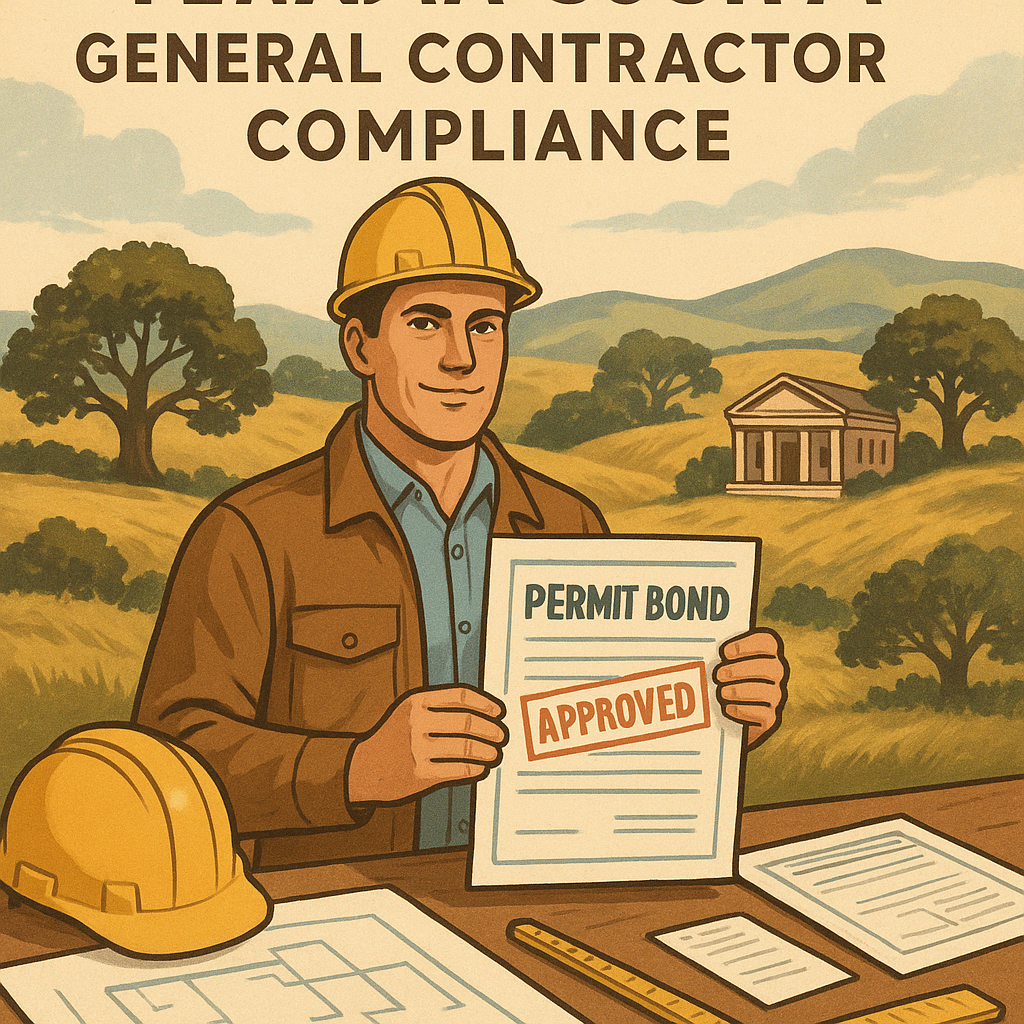
What Is a Permit Bond, and Why Does Tehama County Require One?
Imagine you’re planning a backyard renovation or building a new deck in Red Bluff. You hire a general contractor, they pull a permit from Tehama County, and work begins. But what happens if the contractor doesn’t follow the county’s building codes? That’s where a Tehama County permit bond steps in to protect everyone involved. Think of it as a safety net — not for the contractor, but for the county and, ultimately, for you as a property owner.
A permit bond is a type of surety bond. It’s a three-party promise between the contractor (the principal), the county (the obligee), and a surety company. When a general contractor obtains a building permit in Tehama County, they may need to post this bond to guarantee that their work will comply with all local codes, ordinances, and regulations. It’s a financial assurance that any violations will be corrected — or that the county will have funds to fix things if the contractor doesn’t.
In simple terms, the bond says: “If I mess up and don’t follow the rules, the county can use this bond to make it right.”
Tehama County’s “Compliance Only” Bond Explained
You might notice the phrase General Contractor – Compliance Only appears right alongside the permit bond requirement. This wording matters because it clarifies that the bond specifically guarantees compliance with county building standards, not other types of performance like finishing on time or sticking to a contract budget.
Let’s break that down. Some bonds cover a contractor’s entire job performance — materials, workmanship, and timelines. A compliance-only bond is more focused. It reassures Tehama County that your project won’t create safety hazards, encroach on setbacks, or ignore stormwater rules. The bond doesn’t replace your personal contract with the builder; it simply ensures the county’s rules are followed. That’s why it’s called a permit bond — it’s tied directly to the building permit issued by the county.
How Does a Compliance Bond Protect the Public?
You might wonder, “If I’m hiring the contractor, why does the county care so much?” Great question. When a general contractor pulls a permit, the work becomes part of Tehama County’s public record. The county has a duty to make sure every structure is safe, properly placed, and built to code — not just for you, but for future owners, neighbors, and the community. If a contractor ignores setback requirements and builds too close to a property line, or fails to reinforce a retaining wall correctly, that mistake can affect drainage, cause erosion, or even create a safety risk for others.
The compliance bond gives the county a direct financial tool to address these issues without having to chase down an unresponsive contractor. If the contractor won’t fix a code violation, the county can file a claim against the bond. The surety company then investigates and, if the claim is valid, pays to bring the project up to code — up to the bond’s full amount. The contractor is ultimately responsible for repaying that money, but the public and the county never have to wait for a court case.
Who Needs a General Contractor Permit Bond in Tehama County?
Not every construction project triggers this requirement. In Tehama County, the permit bond is typically mandated for specific types of work that carry higher risk of non-compliance, such as new home construction, major additions, large accessory structures, or commercial tenant improvements. Sometimes even smaller projects, like decks over a certain height or pools, can fall under the bond rule.
If you’re a general contractor working in unincorporated areas of the county — places like Cottonwood, Los Molinos, or Gerber — the County of Tehama Building Department is your go-to authority. They will let you know during the permitting process whether a Tehama County permit bond is needed. The county often requires the bond before the permit can be issued, so it’s smart to plan ahead.
A handy rule of thumb: if the project’s valuation is significant and the work touches structural, grading, or life-safety elements, you’ll likely be asked to post a compliance bond. Even if you hold a California state contractor license, the county may still impose this extra layer of assurance. The bond requirement isn’t about questioning your skill — it’s about giving the local government a predictable remedy if something goes off track.
How Does the Bonding Process Work?
Securing a Tehama County general contractor permit bond is simpler than you might think. It usually involves just a few steps:
- Determine the required bond amount. The county will specify the dollar figure. It might be a flat amount like $5,000 or $10,000, or it could be based on the project’s estimated cost. Always confirm this with the Building Department before you apply.
- Apply with a surety bond provider. You can go through an agency that specializes in contractor bonds. They’ll ask for basic business information and sometimes run a soft credit check, especially if the bond amount is higher.
- Pay the premium. You don’t have to pay the full bond amount. Instead, you pay a small percentage — often 1% to 5% of the total bond, depending on your credit and financial profile.
- Receive your bond form. The surety company issues a bond document that you’ll submit to Tehama County along with your permit application.
- Keep it active. The bond typically remains in force for the duration of the permit and a set period afterward to cover latent violations. Once the project passes final inspection and the county closes out the permit, the bond can be released.
It feels a lot like buying an insurance policy, but remember — a bond is not insurance for the contractor. If a claim is paid, the contractor must reimburse the surety company in full. That keeps accountability squarely on the person doing the work.
What Does a Tehama County Permit Bond Cost?
Cost is one of the first questions contractors and homeowners ask. The good news? For a compliance-only bond tied to a building permit, the price is often very manageable. Premiums can be as low as $100 for smaller bonds, climbing to a few hundred dollars for larger requirements. The exact number depends on three main factors:
- The bond amount set by the county. A $5,000 bond costs less than a $15,000 bond.
- Your credit score. Contractors with good credit usually get the best rates — sometimes as low as 1% of the bond amount.
- The surety company’s underwriting appetite. Some providers specialize in bonds for contractors and offer competitive pricing even for higher-risk profiles.
Because these bonds are considered relatively low-risk for sureties (most contractors do comply), the process is quick and affordable. Many contractors roll this cost into the overall project budget. And if you’re a homeowner managing a project and wondering about this fee, it’s perfectly reasonable to ask your contractor about it early on — transparency builds trust.
Common Scenarios That Trigger a Bond Claim
Understanding what might cause a claim helps you appreciate why the county insists on this bond. Imagine a general contractor begins framing an addition in a flood zone but doesn’t follow the elevation requirements Tehama County mandates for flood safety. The county inspector catches the error during a site visit. The contractor refuses to make changes, perhaps because it will cost too much to redo. The county can then pursue a claim on the permit bond to cover the expense of bringing the work into compliance.
Another example: a pool contractor fails to install proper safety barriers as required by Tehama County’s pool code. The homeowner is left with a dangerous situation. While the bond’s primary purpose is to protect the county’s interests, the correction often directly benefits the homeowner. In many cases, the county will use bond funds to hire a different contractor to fix the issue, giving you peace of mind without a legal battle.
Claims do require documentation — photo evidence, inspection reports, and written notices to the contractor are usually enough for the surety to review. A well-run project rarely sees a claim, but the bond’s existence encourages everyone to stay on the straight and narrow.
Contractor License vs. Permit Bond: Clearing Up Confusion
If you’re a general contractor in California, you already know about the $15,000 contractor license bond required by the Contractors State License Board (CSLB). That bond protects consumers against certain violations of state law. So why do you need a separate Tehama County permit bond?
Think of them as two different shields. The CSLB license bond covers broader issues like poor workmanship or license law violations statewide. The county’s compliance-only permit bond zooms in on one specific project and one set of local rules — building setbacks, grading limits, fire safety, and similar county-level codes. The county doesn’t always have a direct claim on your state bond unless the violation also breaks state law. The local bond fills that gap, giving Tehama County a tool it can use immediately without waiting for state-level processes.
Many contractors learn that carrying both bonds is simply part of doing business across multiple jurisdictions. It’s a sign of professionalism and local respect.
How to Keep Your Project Smooth and Bond-Friendly
Whether you’re a contractor or a property owner, a little preparation goes a long way. Here are some practical tips:
- Talk to the Tehama County Building Department early. Ask them directly, “Will my project need a permit bond, and if so, how much?” They’re your best source for exact numbers.
- Choose a bond provider familiar with California municipal bonds. They’ll know the county’s standard form and submission process, reducing back-and-forth.
- Keep lines of communication open. If a code issue pops up during construction, address it immediately. Most bond claims happen because a small problem was ignored until it became a big one.
- Document your work. Take photos at every stage, and keep copies of inspection sign-offs. If a dispute ever arises, you’ll have a clear record to show the surety or the county.
- Finish strong. After final inspection, request a formal closure of the permit. This starts the clock on bond release and officially ends the county’s active oversight.
Adopting these habits helps you work in harmony with the bond requirement rather than seeing it as a hurdle. It’s yet another tool that makes sure your project adds lasting value, safely and legally.
What Happens When the Job Is Done?
Once the construction passes all required inspections, the county will issue a certificate of occupancy or a final sign-off. At that point, the permit is closed, and the bond’s active duty is essentially finished. Some counties require the bond to stay in place for a short “maintenance” period — for example, six months after completion — to cover any latent defects that might surface. Tehama County’s specific rules can vary, so always confirm the exact release conditions with the building official.
The good news is that the bonding company will cancel the bond or mark it as completed once the county releases it. You don’t have to keep paying premiums forever. If you’re a contractor who frequently works in the county, you might find it more efficient to maintain an annual blanket bond if the county allows it. This can cover multiple permits without needing a new bond each time. It’s worth asking about during your next conversation with the building department.
Embracing Compliance as a Mark of Quality
At first glance, a permit bond might seem like just another piece of paperwork. But when you look closer, it’s a powerful signal. A contractor who readily secures a Tehama County general contractor permit bond shows they respect local rules and care about the community’s safety. For homeowners, knowing that such a bond is in place offers a quiet reassurance — a sign that the builder isn’t cutting corners.
So the next time someone mentions a compliance-only permit bond in Tehama County, you can nod with confidence. It’s not red tape; it’s a promise etched in paperwork, backed by real financial responsibility, standing guard over every nail driven, every wall raised, and every roof secured.
Leave a Reply