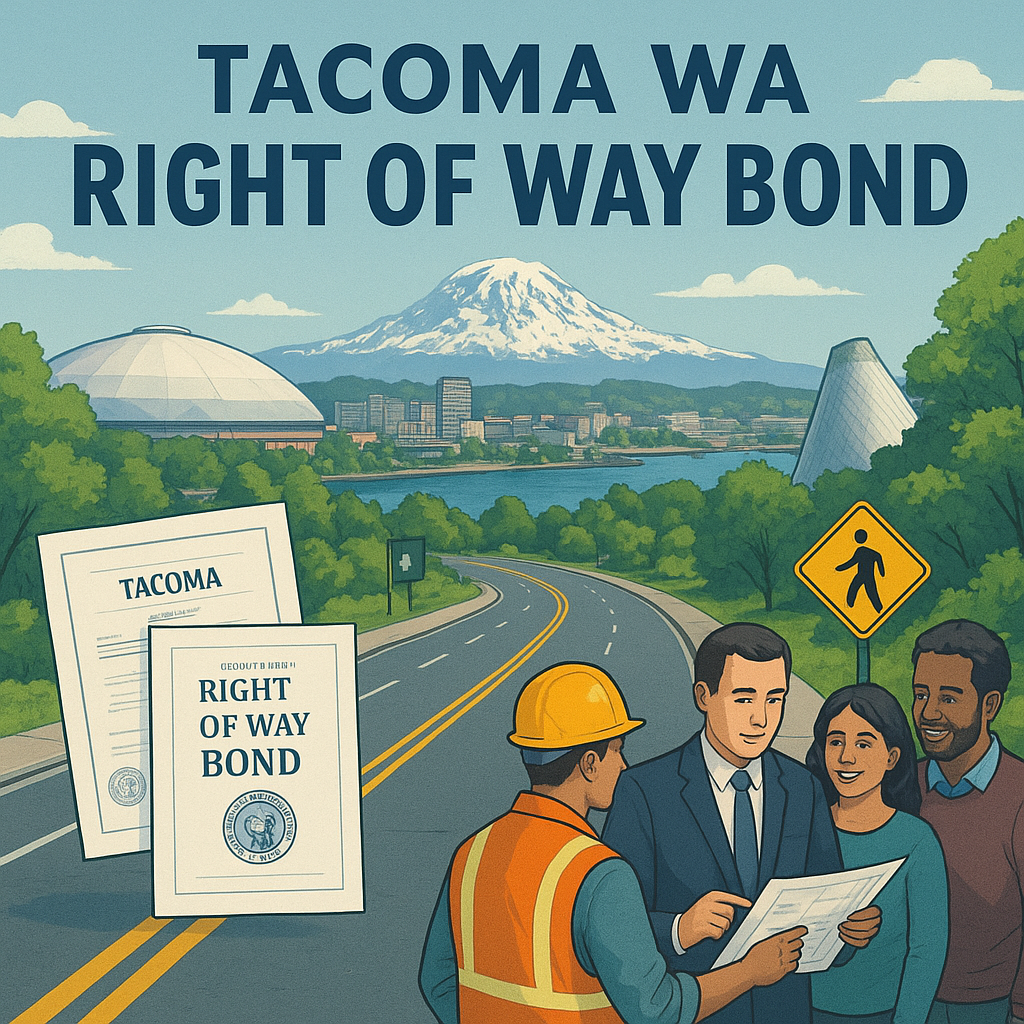
Have you ever noticed construction crews digging up sidewalks or installing new utility lines near your street and wondered what keeps them accountable? If you live in Tacoma, Washington, there’s a behind-the-scenes requirement called a Right of Way Bond that plays a big role. You might not see it, but it’s working to protect the roads, sidewalks, and public spaces we all share.
If the phrase “City of Tacoma WA Right of Way Bond” sounds a little intimidating, don’t worry. We’re going to break it down into simple, everyday language. Whether you’re a homeowner curious about an upcoming project, a small business owner planning a renovation, or a contractor getting ready to break ground, this guide will give you the essential facts.
What Exactly Is a Right of Way Bond?
Think of a Right of Way Bond like a security deposit for public property. When someone wants to perform work in the area that belongs to the city—like the strip of grass between the sidewalk and the curb, the street itself, or an alley—they’re entering Tacoma’s right-of-way. The bond is a promise that the work will be done correctly and that the area will be restored to its original condition, or better.
It’s a three-party agreement. The contractor or person doing the work (the principal) buys the bond from a surety company. The City of Tacoma (the obligee) is the one protected. If something goes wrong—say, a patch of sidewalk sinks a year later, or a utility trench wasn’t compacted properly—the city can use the bond to cover repair costs without dipping into taxpayer dollars.
Why Does Tacoma Require This Bond?
Imagine you’re baking a cake in a friend’s kitchen. You promise to clean everything up and replace any dish you break. Your friend trusts you, but they still might ask for a small deposit just in case. Tacoma’s right-of-way is our shared kitchen. Hundreds of projects dig, cut, and alter public spaces every year. The bond ensures that residents don’t get stuck with a messy, unsafe street because one contractor cut corners.
The City of Tacoma, Washington, takes its infrastructure seriously. From cracked pavement to damaged underground pipes, one incomplete restoration job can cause safety hazards and expensive repairs. A Tacoma WA Right of Way Bond holds the permit holder financially responsible. It’s not a punishment—it’s a practical way to keep neighborhoods safe and beautiful.
Who Needs a Right of Way Bond in Tacoma?
You might be surprised by how many projects fall under this requirement. It’s not just huge construction companies. Here are some common scenarios:
- Utility companies installing new gas lines, water mains, or fiber-optic cables.
- Homeowners hiring a contractor to replace a sewer lateral that extends into the street.
- Landscapers working on a property’s frontage where the sidewalk and planting strip are part of the city’s right-of-way.
- Driveway installers creating or expanding a curb cut that connects to the roadway.
- Event organizers placing temporary structures or stages in a public alley or street.
If your project involves any excavation, obstruction, or alteration of a public area maintained by the city, there’s a very good chance you’ll need a permit—and a bond to go with it. The exact type of bond can vary. You might encounter the term Right of WayTacoma WA Right of Way Bond in official paperwork, but it all points to the same core protection.
How Does the Bond Process Work?
Getting a Right of Way Bond isn’t as complicated as it sounds. The process is designed to be straightforward so you can focus on your project.
Step 1: Confirm the Bond Amount
The city will tell you how much coverage you need. The bond amount is often based on the scope of the work—things like the length of a trench, the type of surface being disturbed, or the estimated cost of restoration. For smaller jobs, you might see a flat minimum bond. For larger ones, the amount can run into the tens of thousands of dollars.
Step 2: Apply with a Surety Company
You reach out to a bond agency or surety provider. They’ll ask basic questions about your business, your credit history, and your experience. Think of it like a quick financial checkup. They want to see that you’re capable of completing the project correctly so they can confidently back your promise.
Step 3: Pay a Premium
You won’t pay the full bond amount. Instead, you pay a small percentage as a premium. For many applicants, this can be as low as 1% to 5% of the total bond. Someone with strong credit and a solid track record might secure a $10,000 bond for a few hundred dollars. It’s a cost-effective way to meet the city’s requirement.
Step 4: File the Bond with Tacoma
Once issued, the surety company gives you a bond form. You’ll submit this document to the City of Tacoma along with your permit application. The bond stays active as long as the project is underway and typically includes a maintenance period after the work is done—often one or two years—to ensure the restoration holds up through the seasons.
What Happens If Something Goes Wrong?
Let’s paint a picture. A contractor has finished installing a new water line under your street. The pavement looks fine. Six months later, heavy rain reveals that the trench wasn’t compacted properly, and a sinkhole forms. That’s a problem nobody wants to wake up to. The city inspects the site and determines the contractor didn’t meet the restoration standards.
Because a City of Tacoma WA Right of Way Bond is in place, the city can file a claim. The surety company investigates. If the claim is valid, the surety pays to fix the sinkhole—up to the full bond amount. Then, the surety will turn to the contractor and ask to be reimbursed. A bond isn’t insurance that lets the contractor walk away. It’s a financial guarantee that makes the contractor ultimately responsible.
What Affects the Cost of Your Bond?
You’re probably wondering, “How much will this set me back?” The premium you pay depends on a few personal and project-related factors. Lenders and surety companies look at:
- Personal credit score. A higher score often means a lower premium. It shows you’re financially reliable.
- Business experience and history. If you’ve completed similar projects without claims, providers see less risk.
- The bond amount required. Naturally, a $5,000 bond costs less in premium than a $50,000 bond, though the rate might stay similar.
- Financial stability. Some providers may review your company’s assets or liquidity for larger bonds.
Even if your credit isn’t perfect, you can still get bonded. There are programs designed to help contractors at every stage. Just expect to pay a slightly higher percentage. It’s always smart to compare quotes from a few surety specialists. You might find a better rate or a company more comfortable with your particular situation.
Why This Bond Is Good News for Tacoma Residents
You might never need to buy a Right of Way Bond yourself, but as a resident, you benefit from the system every day. The bond protects the tax base. Without it, every failed restoration would fall on the city’s maintenance budget—your money. The bond also encourages contractors to do the job right the first time because they know poor work will come back to haunt their finances.
It also keeps the sidewalks walkable, the streets smooth, and the curbs intact. Next time you see a crew working near the road, you’ll know there’s a silent safety net woven into the very pavement they’re repairing.
Frequently Asked Questions About Tacoma’s Right of Way Bond
Is this the same as a contractor license bond?
No, they serve different purposes. A contractor license bond is typically required to obtain your business license and guarantees you’ll follow state laws. The Right of Way Bond is project-specific and focuses on protecting public property during construction. You often need both to legally perform right-of-way work in Tacoma.
Can a homeowner get this bond, or does the contractor handle it?
Usually, the contractor or utility company pulling the right-of-way permit secures the bond. However, if a homeowner is acting as their own general contractor and pulling permits for something like a major sewer line replacement that extends into the street, the city may ask the homeowner to provide the bond. It’s always best to check with Tacoma’s Public Works Department before starting any project that touches the public right-of-way.
How long does the bond last?
The bond must remain active throughout the construction and for a specified warranty period afterward. In Tacoma, that warranty period can be one or two years, depending on the type of work. For example, pavement cuts often require a two-year maintenance bond. After that time, the bonding company will release the obligation if no claims have been filed.
What if I let my bond expire before the maintenance period ends?
That’s risky. The city can issue a stop-work order, revoke your permit, or even require you to tear out and redo the work. Always keep your bond current until you receive a written release from the city. Mark the expiration date on your calendar and renew in plenty of time.
Making Sense of the Paperwork: Your Next Steps
If you’re planning a project that digs into a street, sidewalk, or alley in Tacoma, your first call should be to the city’s permit office. Ask specifically about the right-of-way permit requirements and the bond amount they will assign. Once you have those details, you can reach out to a surety bond professional who understands the City of Tacoma, Washington right-of-way rules.
Keep in mind that the bond is just one piece of the puzzle. You’ll still need a solid plan, safe work practices, and a commitment to leaving the public space as good as—or better than—you found it. When everyone plays their part, the whole neighborhood wins.
So, whether you’re a contractor eyeing a new job or a curious neighbor watching the street transform, you now have a clear view of what a Right of Way Bond is all about. It’s more than paperwork; it’s Tacoma’s promise to keep our community connected and protected, one square foot at a time.
Leave a Reply