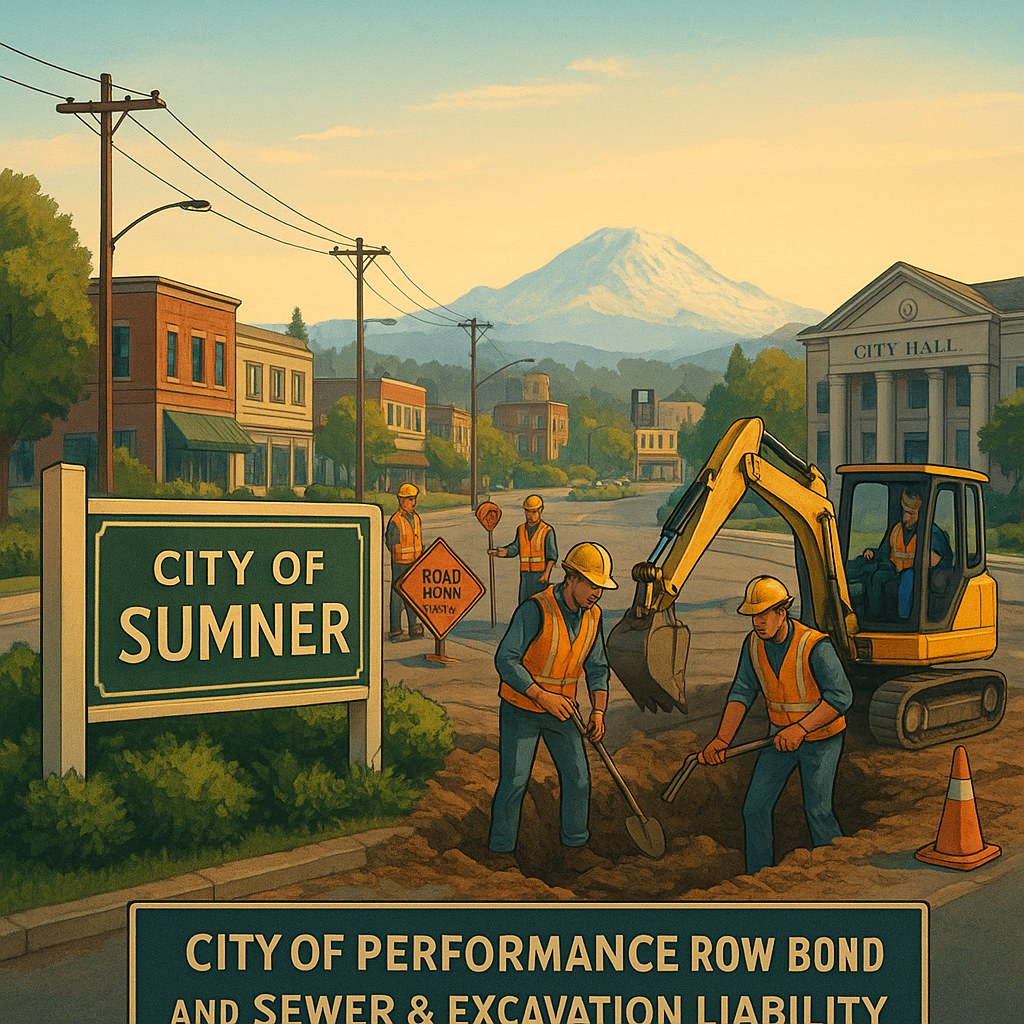
If you’re a sewer or excavation contractor working in the City of Sumner, Washington, you’ve probably heard the term “performance bond” more times than you can count. Maybe you’ve even winced a little. Bonds can feel like one more hoop to jump through, but they’re actually a safety net that protects everyone involved — from the city and its residents to your own business. Let’s break down what these bonds really mean, how liability works, and why the City of Sumner’s Right-of-Way (ROW) performance bond matters so much for your next underground project.
What Exactly Is a Performance Bond?
Think of a performance bond as a promise with financial backing. It’s a three-party agreement between your contracting company (the principal), the entity requiring the work to be done (the obligee — in this case, the City of Sumner), and a surety company that guarantees your performance. If you fail to complete the project according to the contract terms, the surety steps in to make things right. That could mean funding the completion of the work or compensating the city for any losses.
It’s easy to confuse a performance bond with insurance, but they’re not the same. Insurance protects you against accidents or unforeseen events. A performance bond protects the city and taxpayers if your work doesn’t meet the required standards. For Sumner sewer and excavation contractors, this bond is often a non-negotiable part of pulling a permit to dig in public rights-of-way.
Why Sumner Requires Performance Bonds for Sewer and Excavation Work
Sumner, like many growing Washington cities, keeps a close eye on its underground infrastructure. Every time a sewer line is installed, repaired, or upgraded beneath a street, sidewalk, or public utility easement, the work can disturb what’s already there. Imagine a contractor digging a trench, hitting an unmarked water line, and leaving the site without properly backfilling and compacting the soil. Six months later, the road surface sinks, creating a dangerous pothole and hefty repair bills for the city. Without a performance bond, those costs might fall directly on taxpayers.
By requiring a City of Sumner performance ROW bond, the municipality ensures that the contractor has skin in the game. The bond amount is typically calculated based on the scope of the project, covering the estimated cost to restore the right-of-way to its original condition should the contractor fail to do so. It’s not a penalty — it’s proactive protection.
Breaking Down the Sumner City Performance ROW Bond
The “ROW” in performance ROW bond stands for “Right-of-Way.” That includes streets, alleys, sidewalks, and any publicly owned strip of land where utilities run. Whenever your excavation disturbs these areas, the city wants a guarantee that you’ll leave the site in a safe, functional state. The bond functions like a security deposit. Complete the job correctly, and the bond is released. Walk away or do shoddy work, and the city has recourse.
Sumner’s requirements aren’t just a random bureaucratic hurdle. They’re aligned with state codes and local ordinances designed to manage growth responsibly. The bond amount may vary based on the linear feet of trenching, the depth of excavation, and the type of surface being restored (asphalt, concrete, landscaping, etc.). A small repair on a residential street might require a lower bond than a major sewer main replacement under a busy arterial.
Third-Party Liability: Who Else Is on the Hook?
Here’s where things get extra important for Sumner’s sewer and excavation contractors. Performance bonds address the completion of the work, but they don’t cover damage to third parties — think of a neighboring business, a homeowner, or a passing vehicle — that might get caught up in the construction mess. That’s where third-party liability coverage comes in.
Third-party liability insurance protects you if your work accidentally damages someone else’s property or causes bodily injury. For example, say your crew is replacing a sewer lateral and the trench collapses, undermining the foundation of the adjacent house. Your performance bond with the city won’t pay for that homeowner’s structural repairs. Your general liability insurance would, assuming the policy covers the specific risks of excavation. In many cases, the city will require proof of adequate liability insurance before you can even qualify for the performance ROW bond.
The connection is crucial: Sumner needs to know that if something goes sideways underground, public funds aren’t left covering private damage. Your insurance carrier and your surety bond company essentially work together to create a comprehensive safety net. Without both, you’re leaving yourself and the city dangerously exposed.
How Liability Flows in a Typical Sumner Sewer Project
Let’s walk through a real-world scenario. You’re hired to install a new sewer main along a busy corridor in Sumner. You’ve secured the performance ROW bond and have a solid general liability policy. During excavation, your operator nicks a fiber optic line that serves a local bank. Internet service goes down for two days. Who’s responsible?
First, the immediate repair costs for the utility line might fall under your utility damage coverage (often an extension of liability insurance). The bank’s lost business revenue, however, could become a third-party claim if it’s determined you were negligent in not properly locating existing utilities. Your insurance steps in to handle that claim up to your policy limits. The performance bond? It’s still intact, focusing only on whether you finish the sewer work and restore the pavement. This layered protection is exactly why Sumner mandates proof of both bonding and insurance before issuing that permit.
Common Pitfalls for Contractors (and How to Avoid Them)
Even seasoned sewer and excavation contractors occasionally stumble over the bonding and liability requirements. Here are a few trouble spots to watch out for:
- Underestimating bond costs. The premium for a performance ROW bond is typically a small percentage of the total bond amount, often between 1% and 3%. However, that percentage depends on your company’s financial health and credit history. Waiting until the last minute can lead to rushed applications and higher rates.
- Assuming general liability covers everything. Standard liability policies often have exclusions for certain types of excavation work, such as blasting or trenchless methods. Always review your policy’s underground endorsements with your agent.
- Ignoring notice requirements. Sumner may require you to notify the city at specific project milestones — before backfilling, for example — so that an inspector can verify the work. Skipping these steps can trigger bond claims even if the work ends up being acceptable.
- Mixing up bond types. A ROW bond is not the same as a bid bond or a payment bond. Each serves a different purpose. Make sure you’re applying for precisely what the City of Sumner requires for the specific permit you’re pulling.
Simple Steps to Secure Your Sumner Performance ROW Bond
Getting bonded doesn’t have to be a headache. Start early and keep these steps in mind:
1. Know your project’s scope. Gather the job specifications, the estimated cost to restore the right-of-way, and the city’s bond form. Sumner often provides a standard bond form that spells out exactly what the surety must agree to.
2. Reach out to a surety broker. A broker who understands Washington municipal bonds can compare rates from multiple surety companies. They’ll evaluate your business’s financial statements, work history, and credit.
3. Prepare your paperwork. You’ll typically need business financials, a contractor’s questionnaire, and sometimes personal financial information for the business owners. The more transparent you are, the smoother the process.
4. Align your insurance. Before the bond is issued, the surety may request proof of general liability insurance with adequate limits and coverages that match Sumner’s requirements. Have your certificate of insurance ready.
5. Submit the bond to the city. Once the surety issues the bond, you’ll send the original signed and sealed document to Sumner’s Public Works or Engineering Department as part of your permit package.
What Happens If a Claim Is Filed Against Your Bond?
Let’s be real — no contractor wants to face a bond claim. But understanding the process takes away some of the fear. If the city believes you’ve failed to perform, they will notify the surety company. The surety investigates. If the claim is valid, the surety may either finance the completion of the work using another contractor or pay the city the bond amount up to the penal sum. Remember, the bond is not a gift — you’ll have to reimburse the surety for any payouts. That’s the “indemnity” part of the bond agreement. So a claim can hurt your wallet and your future ability to get bonded.
The best defense? Document everything. Take date-stamped photos of the work at every stage, keep all inspection reports, and communicate openly with Sumner’s project managers. If a dispute arises, you’ll have the evidence to show you met your obligations.
Why This Matters for Sumner’s Growing Community
Think of the performance bond and liability requirements as part of a larger promise — one that ensures Sumner’s infrastructure remains safe, reliable, and well-maintained even as new homes and businesses spring up. Every sewer tap, every storm drain connection, and every pavement cut affects daily life. When contractors meet these standards, everyone wins. The city gets durable infrastructure, residents avoid headaches, and your business builds a reputation for reliability that leads to more work.
The next time you’re bidding a sewer or excavation job in the City of Sumner, embrace the bonding process as a tool, not an obstacle. It signals to the city and your clients that you’re a serious professional who stands behind your work. And in an industry where what’s buried out of sight ultimately matters most, that commitment is everything.
Leave a Reply