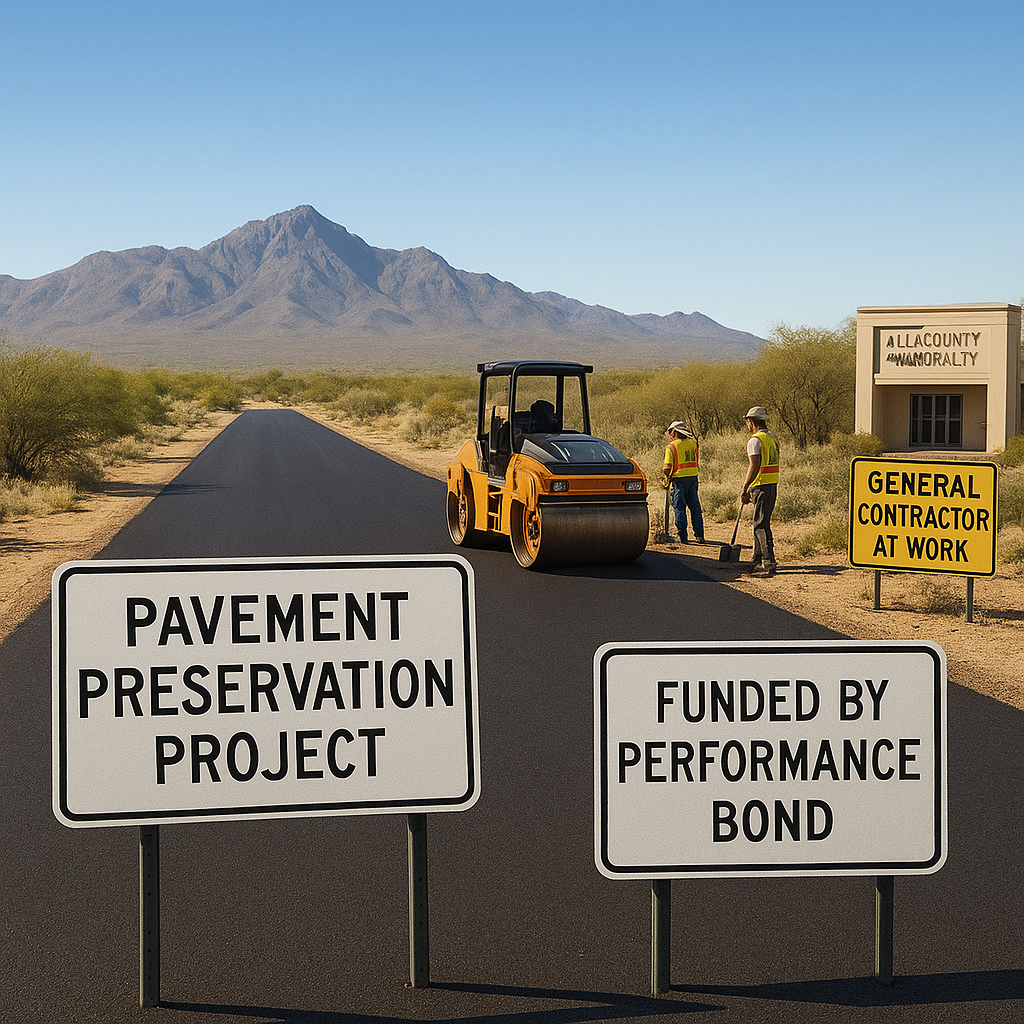
Have you ever driven down a freshly treated road in Pima County and wondered how the county makes sure the job gets done right? Roads take a beating from the Arizona sun, monsoon rains, and daily traffic. To keep them safe and smooth without breaking the bank, local governments turn to pavement preservation—a smart, proactive way to extend the life of existing roads. But what happens if the contractor doesn’t finish the work or does a poor job? That’s where a pavement preservation performance bond steps in, acting like a financial promise that protects everyone’s interests. Let’s break it down in simple terms so you can understand exactly what this bond is, who needs it, and why it matters in Pima County.
What Is a Pavement Preservation Performance Bond?
Think of a performance bond as a safety net. It’s a three-party agreement that guarantees a contractor will complete a project according to the terms laid out in the contract. If the contractor fails to deliver, the bond covers the cost of finishing the job or correcting the mistakes. In the world of pavement preservation—think slurry seals, crack sealing, chip seals, and micro-surfacing—this bond is specifically designed for public works projects that focus on maintaining and protecting roads rather than full-depth reconstruction.
The bond isn’t insurance for the contractor; it’s a guarantee to the project owner (in this case, Pima County or a municipality within the county) that the work will be performed as promised. If the contractor defaults, the surety company that issued the bond steps in to either hire another contractor or compensate the county for the financial loss. It’s like having a co-signer on a loan who promises to make things right if the borrower can’t pay.
Why Does Pima County Require These Bonds?
Pima County government uses public funds—your tax dollars—to pay for road maintenance. Officials have a responsibility to protect that investment. By requiring a performance bond for pavement preservation contracts, the county ensures that:
- The project won’t be left half-finished, wasting time and money.
- Taxpayers aren’t stuck with the bill for fixing substandard work.
- Only qualified, financially stable contractors can bid on the work, because surety companies vet them thoroughly before issuing a bond.
Basically, the bond requirement sets a quality bar and a safety cushion. It’s a standard practice in public construction, and Pima County makes it a non-negotiable part of the bidding process for preservation projects.
Who Needs This Bond? The General Contractor’s Role
If you’re a general contractor looking to win a pavement preservation contract with Pima County or any town within the county, you’ll almost certainly need to provide a performance bond. The bond is tied to the specific contract and runs directly to the municipality. Smaller subcontractors might not need to obtain the bond themselves, but the prime contractor is on the hook to secure it before the first truck rolls out.
Here’s how it typically works: The county releases a request for bids. Interested contractors prepare their proposals. Along with the bid, the contractor includes a bid bond (a separate guarantee that they will enter into the contract if selected). Once awarded, the contractor must then furnish a performance bond—and often a payment bond, too—within a set timeframe, usually 10 to 20 days. Without the bond, the contract isn’t valid, and the county can move on to the next bidder.
Breaking Down the Bond Mechanics
Let’s make the three-party relationship crystal clear:
- The Obligee: This is Pima County or the local municipality that requires the bond. They are the protected party.
- The Principal: That’s you, the general contractor promising to do the pavement work.
- The Surety: The insurance-like company that backs your promise with financial strength and a legal guarantee.
When a problem arises—say the contractor walks off the job after completing only half the crack-sealing route—the county files a claim against the bond. The surety investigates. If the claim is valid, the surety will either step in to manage the completion using another contractor or pay the county the bond penalty (the maximum amount, usually equal to the contract price) so the county can hire someone else. The contractor then must repay the surety for every penny paid out, because the bond is not a free pass.
What Does the Bond Cost?
The cost of a pavement preservation performance bond is typically a small percentage of the total contract value, often between 1% and 3%. For a $500,000 slurry seal project, the premium might be $5,000 to $15,000. The exact rate depends on the contractor’s credit score, financial history, experience, and the bond amount. Contractors with strong financials and a track record of successful public works projects will pay the lowest rates. Newer businesses or those with less-than-perfect credit might need to shop around or work with a surety broker who specializes in construction bonds.
Pavement Preservation 101: What’s Being Bonded
Pavement preservation covers a range of techniques that extend a road’s life without full replacement. Common methods in Pima County include:
- Crack sealing – filling cracks to prevent water from seeping in and causing damage.
- Slurry seal – a thin mixture of asphalt emulsion, aggregate, and water applied to seal and protect the surface.
- Chip seal – spraying a layer of liquid asphalt, covering it with small stones, and rolling it in. Hey, that’s a familiar sight on rural roads!
- Micro-surfacing – a polymer-modified slurry that provides a tough, durable riding surface.
Because these treatments are specialized and must be applied correctly to perform well, the county wants assurance that the contractor won’t cut corners. A performance bond backs the quality and completion of that specific treatment process.
How It Protects the Community
It’s easy to tune out when talk turns to bonds and contracts, but the end result touches everyone who uses Pima County roads. A solid pavement preservation program saves money because maintaining a road is far cheaper than rebuilding it. The bond ensures that those preservation dollars aren’t wasted. If a contractor does sloppy work that fails after a few months, the county has a clear path to remedy. That means fewer potholes, less vehicle damage, and smoother commutes for residents and businesses.
Beyond the physical condition of the roads, the bond requirement encourages fair competition. Only contractors who are serious, stable, and capable can bid, which often leads to better project outcomes. It’s a quiet but powerful tool that keeps local infrastructure investments safe.
Common Questions Contractors Ask
Can I use the same bond for multiple projects? No. Performance bonds are project-specific. Each contract requires its own bond matching the scope and amount of that job.
How long does it take to get bonded? For established contractors, the process can be as quick as a few days once the contract is secured. First-timers should allow a week or more because the surety needs time to review financials and experience.
Does my personal credit matter? Yes, especially for smaller or mid-sized contractors. Surety companies look at the owner’s personal credit as a measure of reliability. Good credit opens doors and lowers premiums.
What if I can’t get bonded? Some specialty programs help new or emerging contractors with less-than-perfect credit obtain bonds, often with a higher premium and additional collateral. Working with a knowledgeable surety broker is the best move.
Tips for Securing Your Pavement Preservation Bond in Pima County
If you’re aiming to bid on county jobs, start preparing early. Here are a few practical steps:
- Build a solid business financial profile. Keep your books clean, maintain working capital, and avoid overextending credit lines.
- Partner with a surety broker who knows Arizona. Local expertise helps because the broker will understand Pima County’s specific requirements and the regional construction market.
- Gather your paperwork ahead of time. You’ll typically need business and personal financial statements, a resume of past projects, references, and the specific contract details.
- Start small. If you’re new to public work, consider pursuing smaller preservation contracts first. A history of successfully completed bonded projects makes you much more attractive to sureties for larger jobs later.
- Communicate openly with the surety. If problems arise during a project, let the surety know early. They may be able to help resolve issues before they turn into a claim.
What Happens Without a Bond?
Imagine a chip seal project on a busy Marana highway that grinds to a halt because the contractor went out of business. Without a performance bond, the county would have to dip into emergency funds, go through a new bidding process, and accept a possibly higher price to finish the work. Delays, added costs, and aggravated drivers are the result. The bond prevents that scenario from becoming a crisis. It’s an insulating layer that keeps public projects moving forward, no matter what happens to the original contractor.
Why This Bond Matters Now More Than Ever
Arizona’s growth means more traffic, more wear, and higher expectations for road quality. Pima County is consistently working to balance budgets while maintaining a vast network of streets and highways. Pavement preservation is a key strategy, and performance bonds make sure those efforts deliver what they promise. For contractors, understanding and obtaining the right bond isn’t just red tape—it’s a competitive advantage that shows you’re ready to meet the county’s standards.
So, the next time you glide over a freshly sealed road near Tucson, remember there’s a performance bond quietly backing that smooth ride. It’s not the most exciting topic, but it’s one of those behind-the-scenes pillars that keep our communities moving safely and efficiently.
Leave a Reply