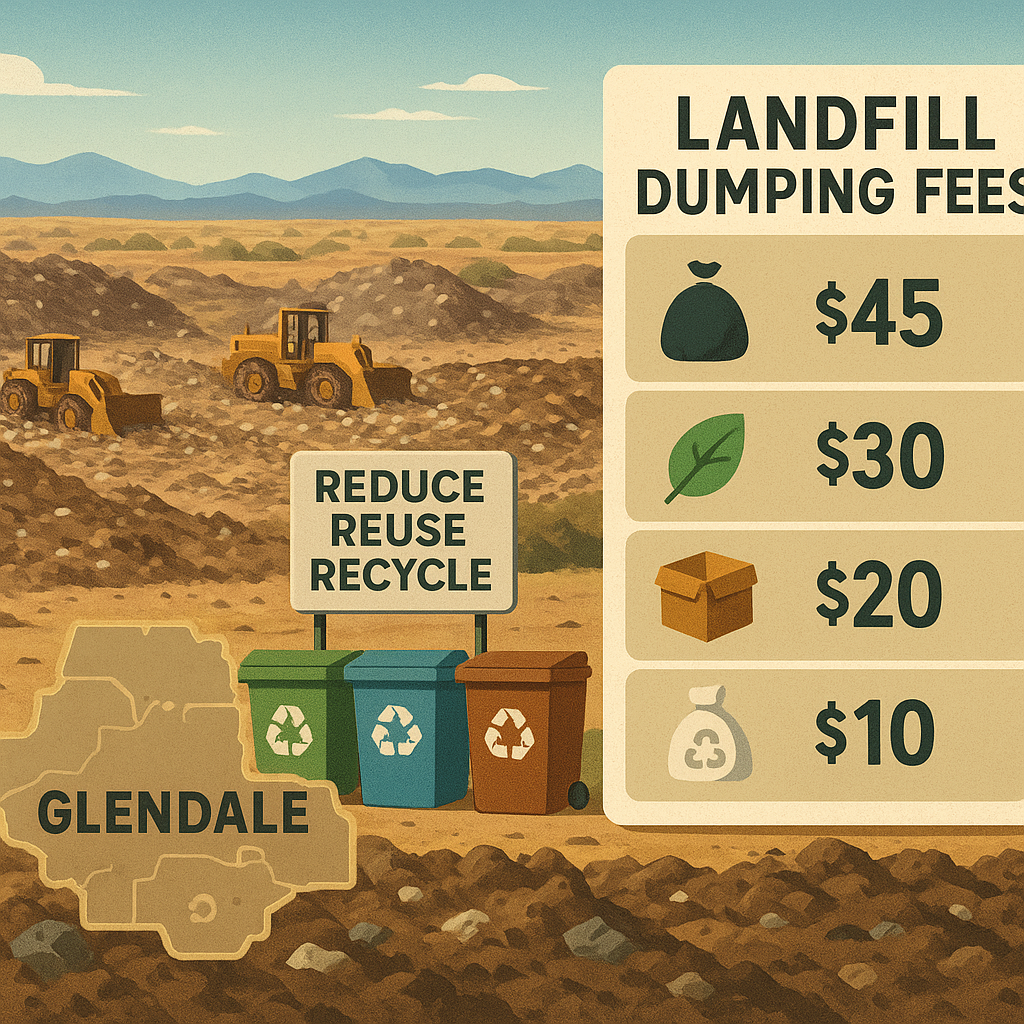
What’s the Deal with Landfill Dumping Fees in Glendale?
Have you ever looked at a landfill bill and thought, “Wait, how did it get this high?” If you live or run a business in Glendale, Arizona, you’re not alone. The city’s landfill dumping fees can sneak up on you, especially if you don’t know how they’re calculated or what tools can keep costs down. But here’s the good news: once you understand the system, you can trim those expenses without breaking a sweat.
Think of Glendale’s landfill fees like a restaurant menu where prices change based on what you order and how much you pile on your plate. Small loads, separated recyclables, and the right paperwork can all lighten the final tab. And for commercial haulers, a little-known tool called the City of Glendale Landfill Dumping Fees Bond plays a starring role in avoiding surprise charges. By the end of this post, you’ll know exactly how to save money on Glendale Arizona’s landfill dumping fees today.
Understanding the Basics: What Are Landfill Dumping Fees in Glendale?
At its core, a dumping fee (often called a tipping fee) is the price you pay to leave waste at the landfill. The City of Glendale charges these fees to cover the costs of operating the landfill, maintaining environmental safeguards, and planning for future closure. Whether you’re a homeowner cleaning out the garage or a contractor clearing a job site, the scale weighs your vehicle when you arrive and again when you leave. You pay for the difference.
But not all trash is created equal. The city has different rates for municipal solid waste, construction debris, green waste, and recyclables. For instance, mixed loads with a little bit of everything usually cost more than a truckload of clean, separated yard clippings. The logic is simple: material that can be diverted from the landfill saves space and reduces long-term environmental costs. So the fee structure rewards smart sorting.
If you’re a casual visitor, you might pay with cash or card on the spot. If you’re a commercial hauler or business that makes regular trips, the city often requires a more formal arrangement. That’s where the landfill dumping fees bond comes into the picture.
What Exactly Is the City of Glendale Landfill Dumping Fees Bond?
Let’s break this down without any insurance jargon. A City of Glendale Landfill Dumping Fees Bond is essentially a financial promise. Imagine it as a security deposit you might put down for a rental apartment. Instead of making you pay a huge cash deposit upfront, the city allows haulers to post a surety bond that guarantees the dumping fees will be paid on time, every time.
Here’s how the three-way promise works. You (the hauler) purchase the bond from a surety company. The bond says to the city: “If this hauler doesn’t pay the fees they owe, the surety will step in and cover the bill up to the bond amount.” Of course, you’re still ultimately responsible. The surety will come back to you for reimbursement, just like a co-signer would. But for the city, it’s an ironclad guarantee. For you, it’s a way to keep cash in your pocket instead of tied up in a large deposit.
This bond is especially common for businesses that dispose of waste regularly—think roofing companies, landscapers, moving services, and independent trash collectors. It’s not a tax or extra fee you’ll never see again. The bond premium is a small percentage of the total bond amount, often between 1% and 5% for those with good credit. In many cases, the annual cost is far less than the interest you’d lose by ponying up a cash deposit.
Why Does the City Require This Bond Anyway?
Glendale uses the bond requirement to protect its revenue and the environment. Without some form of security, a hauler could accumulate thousands of dollars in dumping fees and then disappear. The bond ensures that the landfill’s operational budget stays healthy, which keeps the gates open for everyone. It also encourages responsible disposal habits because haulers know their payment track record is being monitored. A solid history might even help you negotiate better terms or reduce the bond amount over time.
Simple, Friendly Ways to Save Money on Glendale Dumping Fees
Okay, now for the part you really care about—cutting that bill. Whether you have the bond or you’re just showing up with a pick-up truck, these strategies will make a difference.
1. Sort Your Load Before You Leave Home
This is the single biggest money-saver. Dedicate a few minutes to pulling out cardboard, scrap metal, clean wood, and green waste. Many Glendale residents are surprised to learn that recyclable material often has a lower tipping fee, and some items can even be dropped off for free at designated collection points. Treat your vehicle like a moving sorting bin. Even one separated pile can shave dollars off the scale ticket.
2. Know the Fee Schedule and Discount Days
Landfill rates aren’t a secret. The City of Glendale publishes its current fee schedule online and at the gate. Bookmark that page. Look for reduced rates on certain materials or promotional days when residents can dispose of bulky items at a discount. Sometimes, simply avoiding the busiest hours (when staff may inspect loads more quickly) gives you a chance to discuss your load and point out that half of it is clean green waste. A friendly conversation might help you get the right classification.
3. Use the Right Hauler Bond—And Keep It Current
If your business requires a landfill dumping fees bond, don’t let it lapse. An expired bond can result in immediate suspension of your dumping privileges or cash-only terms with higher rates. Renewing on time is cheaper than paying late penalties or forfeiting accumulated discounts. Also, shop around. Surety bond premiums vary, and some agencies specialize in helping businesses with less-than-perfect credit obtain affordable bonds. A quick phone call to a knowledgeable bond provider could save you hundreds.
4. Compact, Compact, Compact
Air is free, but at the landfill you’re paying by weight. Flatten cardboard boxes, crush plastic containers, and break down anything that takes up unnecessary space. If you’re a contractor, consider using a trash compactor for high-volume debris. The heavier, denser load will have the same weight, but a smaller volume might mean fewer trips—and fewer base fees per visit. Over a month, those fewer trips add up.
5. Explore Alternative Disposal Options
Not everything has to go to the landfill. Glendale and neighboring communities offer transfer stations, recycling centers, and yard waste composting sites that often charge less—or nothing—for specific materials. Concrete and asphalt can sometimes be recycled for road base. Old appliances may contain valuable metal that a scrapyard will pay you to take. A bit of research turns what you saw as garbage into a resource, and that’s a win for both your wallet and the planet.
Common Pitfalls That Inflate Your Dumping Fees
Even smart people fall into these traps. Let’s shine a light on them so you can step right over.
Mistaking the Bond for Insurance. The landfill dumping fees bond is not insurance for your truck or your business. It only guarantees payment to the city. Don’t assume it covers property damage or cleanup costs elsewhere. Combining your bond with proper liability insurance keeps you protected from all angles.
Bringing Unseparated Mixed Loads. I’ve seen trucks pull up with drywall, brush, and an old sofa all tangled together. That load almost always gets classified as the highest-cost category. The scale operator has to assume the worst because sorting is your responsibility, not theirs. Take the extra ten minutes to secure separate piles in your trailer with a tarp or plywood divider. It’s effort that pays.
Ignoring Weight Limits. Overloaded vehicles aren’t just dangerous—they can trigger overweight fines at the landfill or on the road. Plus, the fee per ton might jump once you cross a certain threshold. Know your vehicle’s gross vehicle weight rating and stay under it. If you regularly haul dense material like dirt or rock, smaller loads might actually be cheaper because you avoid penalty rates.
Forgetting to Update Your Bond Amount. As your business grows, you might be hauling more volume. If your bond coverage falls short of your actual usage, the city could ask you to post a larger bond or pay cash for the excess. Proactively adjusting your bond keeps you in good standing and prevents an embarrassing (and expensive) stop at the gate.
How Does the Bond Actually Save You Money?
It might seem backward to spend money on a bond in order to save money. But think about what you’re avoiding. Without a valid bond, you might have to pre-pay a significant cash deposit—say $5,000 or more—just to open a commercial account. That’s money sitting idle. A bond with a $5,000 amount might cost you as little as $100 to $250 per year depending on your credit. The rest of your capital stays in your business, earning interest, buying equipment, or covering payroll. Over time, that flexibility is far more valuable.
Additionally, bonded haulers often enjoy streamlined billing and monthly invoicing instead of paying per trip. This can let you bundle loads and pay in a predictable cycle, avoiding cash flow crunches. Some cities even offer a slight discount for bonded accounts because the administrative cost is lower. It never hurts to ask.
Real-Life Scenario: Turning a Deadline Into a Discount
Let’s paint a quick picture. Alex runs a small junk removal service in Glendale. He’s been paying cash at the gate every time, and his monthly dumping bills hover around $800. After reading up, he gets a $5,000 landfill dumping fees bond for about $150 a year. The city switches him to a monthly billing cycle and classifies him as a trusted hauler. Because he now separates metals and green waste before heading to the landfill, his per-ton cost drops by roughly 15%. His monthly bill shrinks to $680. In year one, after the bond cost, he saves over $1,200. That’s a new set of tires and a team lunch.
Stories like Alex’s are everywhere. The system rewards preparation and responsibility. You don’t have to be a huge corporation to benefit; small changes deliver big returns.
Getting Your Bond: Quick, Easy, and Done
If you’ve decided a bond makes sense for your business, the process is surprisingly uncomplicated. You’ll fill out a short application with basic business information. The surety company checks your credit and issues a quote—often within the same day. Once you pay the premium, the bond is issued and you’ll receive a certificate to file with the City of Glendale. Most bonds run for a year and can be renewed with minimal fuss.
Need a bond but worried about a blemish on your credit? Don’t stress. There are programs for almost every situation, and some sureties look at your overall business health, not just a single score. A quick chat with a bond specialist can uncover options you didn’t know existed.
Wrapping It Up: Start Saving Today
Glendale’s landfill dumping fees don’t have to be a budget buster. By understanding the fee structure, sorting your materials, exploring alternatives, and using tools like the City of Glendale Landfill Dumping Fees Bond, you’re in the driver’s seat. The bond isn’t a burden—it’s a key that unlocks lower costs, better cash flow, and a smoother dumping experience.
So next time you’re loading up the truck, glance at that pile and ask yourself: “What can I separate? Is my bond up to date? And is there a cheaper way to get rid of this?” Those few extra minutes of planning can turn the landfill from a money pit into a predictable line item. Here’s to cleaner loads and fuller wallets!
Leave a Reply