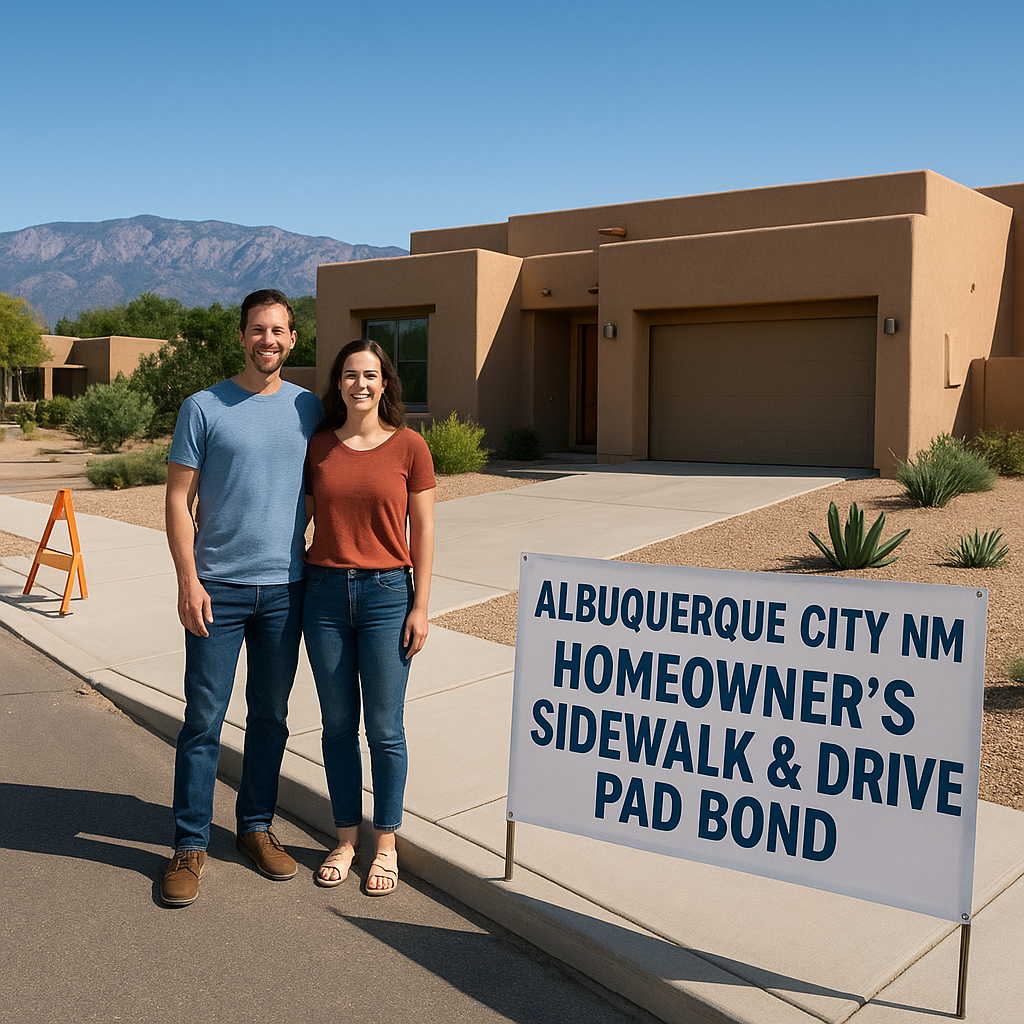
Have you ever looked at a cracked, uneven sidewalk in front of your home and thought, “I really should get that fixed before someone trips”? Or maybe you’re finally ready to widen your driveway, only to discover the project comes with a little more paperwork than you expected. If you live in Albuquerque, New Mexico, and your home improvement plans involve concrete touching the public right-of-way, there’s one term you’ll want to get familiar with right away: the Sidewalk and Drive-Pad Compliance Bond. It might sound like something only contractors need to worry about, but as a homeowner, knowing the ins and outs can save you time, money, and a whole lot of stress.
Think of this bond as a safety net—for you, your neighbors, and the city. It’s a promise that the new concrete outside your home will be safe, sturdy, and up to code. And trust me, it’s much easier to tackle this small requirement upfront than to deal with a failed inspection or an unexpected fine later on. Let’s walk through everything you need to know, step by step.
What Exactly Is a Sidewalk and Drive-Pad Compliance Bond?
Let’s break it down into plain English. A compliance bond is a type of surety bond. If you’ve never dealt with surety bonds before, don’t worry—most people haven’t. A simple analogy is renting an apartment. You give your landlord a security deposit as a guarantee that you’ll leave the place in good condition. If you don’t, the landlord uses that deposit to cover repairs. A compliance bond works the same way, but instead of an apartment, it’s the public sidewalk, curb ramp, or driveway pad that touches the street.
In Albuquerque, when a homeowner (or a contractor hired by a homeowner) does concrete work that affects the public right-of-way, the city wants a guarantee that the finished product will meet all safety and construction standards. The bond is that guarantee. If the work ends up being subpar—like concrete that slopes the wrong way, creates a tripping hazard, or crumbles after just one rainy season—the city can step in and use money from the bond to fix the problem. The best part? If your contractor does the job right, the bond simply expires, and you never pay another cent toward it.
Why Does Albuquerque Require This Bond?
Albuquerque is a city that takes pedestrian safety seriously. With our sunny skies and walkable neighborhoods, people are constantly out strolling, pushing strollers, or using wheelchairs. Uneven or poorly constructed walkways aren’t just an eyesore; they’re a real danger. The city’s Development Services and Department of Municipal Development have a responsibility to make sure every inch of public walkway is up to code.
Now, you might be wondering: “I’m just replacing a small section of my sidewalk. Why all the fuss?” Even a tiny patch can create problems if it’s not done correctly. A slight dip might look harmless, but after a monsoon rain, it becomes a pond. In winter, that water freezes into a slick patch of black ice. The compliance bond puts some gentle pressure on the person holding the trowel to measure twice and pour once. It’s not about creating red tape for the sake of red tape; it’s about making sure your home improvement project doesn’t accidentally turn into a neighborhood hazard.
Who Needs This Bond: Homeowner or Contractor?
Here’s where a lot of confusion creeps in. When you hire a licensed, bonded contractor in Albuquerque, they often handle pulling permits and securing bonds as part of their service. Many concrete pros already carry a blanket contractor bond that covers their projects. But—and this is a big but—not every contractor does. Some smaller operations or general handymen might ask you, the homeowner, to obtain the bond directly. Even if your contractor says they’ll handle it, the ultimate responsibility for the sidewalk or drive-pad’s condition often falls back on the property owner in the long run.
So, who really needs it? The short answer: the person named on the permit. In many cases around the Duke City, a homeowner pulling their own permit for a DIY fix or a small project will be required to post a compliance bond in their own name. If a contractor pulls the permit, their bond might cover it. The smartest move you can make is to ask your contractor point-blank: “Does your bond cover sidewalk and driveway compliance, or do I need to get a separate one?” A trustworthy contractor will give you a straight answer without hesitation.
Common Projects That Trigger the Bond Requirement
You might be surprised by the variety of projects that fall under this umbrella. It’s not just massive driveway extensions. Here’s a quick list of times you’ll likely need to think about a compliance bond:
- Replacing a cracked or uplifted section of sidewalk in front of your house.
- Adding a new driveway cut or widening an existing driveway pad where it meets the street.
- Repairing a depressed curb ramp at a crosswalk near your property.
- Installing a new walkway that connects your front door to the public sidewalk.
- Any concrete work that disturbs the public right-of-way, including the parkway strip between the street and your property line.
If you’re just patching a hairline crack with some sealant, you’re probably in the clear. But the moment you’re mixing bags of concrete and tearing out old slabs, a quick call to the city’s Planning Department can save you a big headache.
How Does the Bond Process Work in Albuquerque?
Navigating city requirements can feel like trying to read a map written in a language you half-remember from high school. But the bond process is actually pretty straightforward once you see it laid out. Let’s walk through a typical timeline for a homeowner.
Step 1: Determine the Scope of Work. Before you do anything, figure out exactly what you want to fix. Is it a single square of sidewalk or a whole new curved driveway? Take photos. Measure. The more details you have, the smoother the permit application will go.
Step 2: Apply for the Right Permit. In Albuquerque, you’ll likely need a permit for work in the public right-of-way. You can start this process at the city’s Building Safety Division or online through their permitting portal. During this step, the city will tell you if a compliance bond is mandatory for your specific project.
Step 3: Purchase the Bond. If a bond is required, you’ll need to obtain one from a surety bond company. You don’t have to trek to some obscure government office; many insurance agencies and specialty bond providers can issue one quickly, often online. The bond amount varies based on the scope of your project but is typically quite affordable. We’re often talking about a bond of a few thousand dollars in coverage, and you only pay a small percentage of that—maybe $100 to $300—as a one-time premium.
Step 4: Submit the Bond and Begin Work. Once you have the bond document in hand, you’ll provide it to the city to finalize your permit. Then, the concrete dust can fly. Make sure your contractor (or you, if you’re the DIY type) follows Albuquerque’s standard specifications for concrete flatwork to the letter.
Step 5: Pass Inspection and Close Out. After the pour has cured and forms are stripped, a city inspector will come out to check the slopes, the finish, and the transitions between new and old concrete. If everything looks good, you get the green light. The bond remains in effect for a specified period (often one or two years) to ensure the work holds up. After that, it expires, and you’re done.
What Does a Compliance Bond Cost?
Deep breath. This is the part that makes homeowners nervous. The good news is that a compliance bond is not a second mortgage. You’re not writing a check for the full bond amount. The dollar figure on the bond (say, $5,000 or $10,000) is the maximum penalty amount the city could claim if the work is completely botched. What you actually pay is the premium, which is a fraction of that total.
The exact premium depends on the bond amount required by the city and the surety company’s rate, usually set between 1% and 3% for someone with decent credit. So, if the city requires a $4,000 bond, your out-of-pocket cost might be as low as $100. Think of it as a small insurance policy for the public’s safety, baked into your project budget. Always factor this cost in when you’re comparing quotes from concrete contractors. A slightly higher contractor quote might include handling the bond for you, which could actually be the more convenient and cost-effective route.
Avoiding the Biggest Headaches: Tips from the Locals
I’ve talked to enough Albuquerque homeowners to spot a few patterns. Here are some real-world tips to keep your project flowing like a smooth concrete finish.
Don’t skip the permit. It’s tempting to just do the work on a quiet weekend and hope nobody notices. But the city’s Right-of-Way inspectors do drive around. Unpermitted work can result in a stop-work order, fines, and even an order to tear out the new concrete and start over. That’s a costly re-do.
Get everything in writing with your contractor. A clear contract should state exactly who is responsible for pulling the permit, who pays for the bond, and who guarantees the work. If a contractor says, “Ah, don’t worry about the bond, we don’t need one for this,” get a second opinion. It’s your property and your liability.
Understand the “parkway” mystery. For many Albuquerque homes, there’s a strip of land between the sidewalk and the curb. The city often has an easement there, but the homeowner maintains it. Work in this zone almost certainly triggers the bond and permit requirements. If your tree roots have turned that area into a concrete wave, brace yourself for a little extra paperwork.
Winter and monsoon seasons matter. While you can technically do concrete work year-round in Albuquerque’s high desert climate, scheduling your pour for a mild, dry stretch ensures the concrete cures properly and passes inspection without weather-related hiccups. A rush job just before a freeze is a recipe for a cracked pad and a bond claim.
Is This Bond the Same as Insurance?
This is a super common question, and the answer is a firm no. Your homeowner’s insurance protects you if a tree falls on your roof or a guest slips in your kitchen. The compliance bond protects the city and the public. If someone trips on your newly poured but poorly graded sidewalk, the city might use the bond to fix the hazard quickly. But the bond doesn’t cover personal injury lawsuits. For that, you’d need your homeowner’s liability coverage. The bond, your insurance, and a good contractor’s license are three separate layers of protection. Keeping them straight in your mind helps you see the full picture of risk management.
Think of it this way: Insurance is a shield for your wallet. A compliance bond is a promise to your community. Both are valuable, but they serve completely different functions.
Ready to Pour a Smoother Future?
At the end of the day, the City of Albuquerque’s Sidewalk and Drive-Pad Compliance Bond isn’t there to make your life difficult. It’s there to make sure that a decade from now, kids can still ride their bikes smoothly down your street, and your neighbor can push a stroller without wobbling dangerously. It’s a small, one-time step that keeps our neighborhoods safe and accessible for everyone.
So, next time you’re dreaming about that crisp, new driveway or a flawless stretch of sidewalk leading up to your adobe home, you’ll know exactly what to ask about. Do a little homework, chat openly with your contractor, and secure that bond if it’s needed. Then, you can stand back and admire the finished product with the satisfying knowledge that you crossed every T and dotted every I. After all, a home that’s built right on the outside makes everything inside feel that much more secure.
Leave a Reply