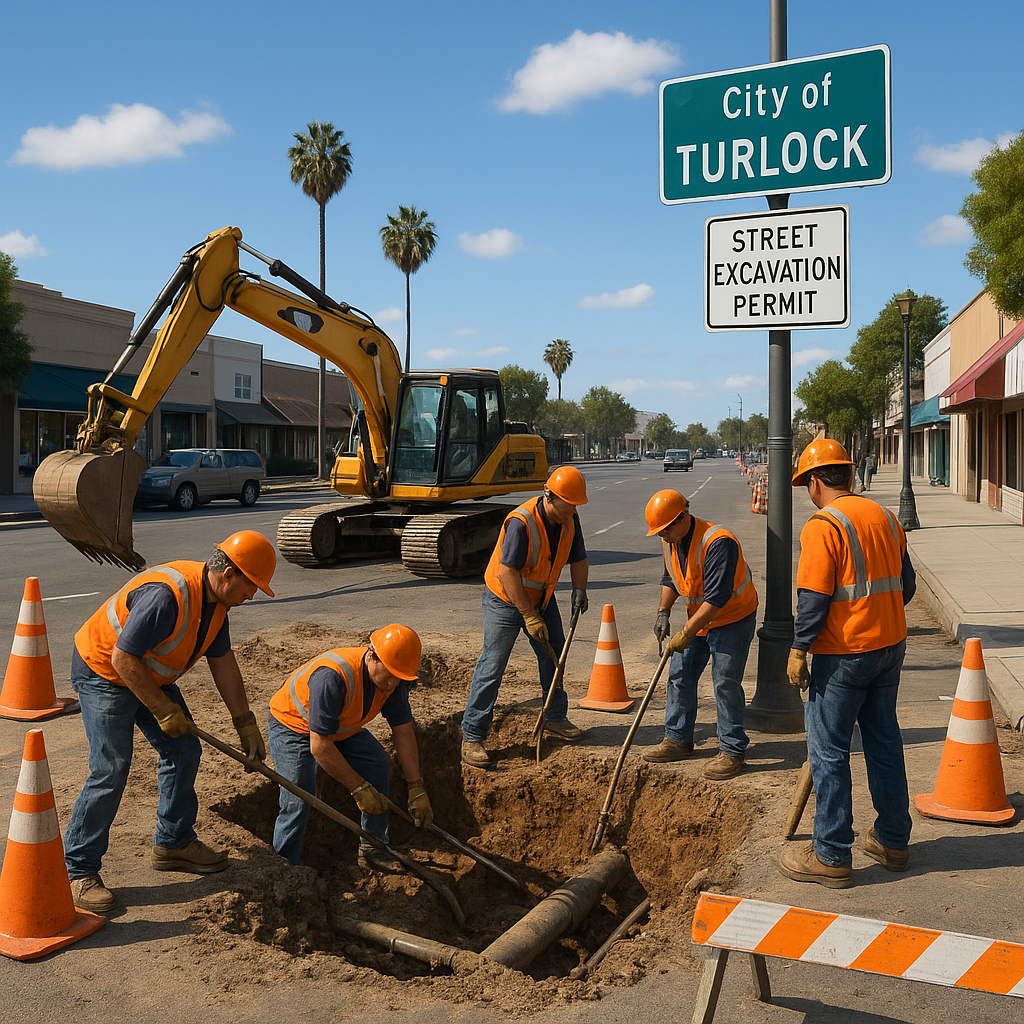
Ever found yourself staring at a patch of pavement, knowing you need to dig it up but dreading the paperwork? Whether you’re a homeowner installing a new sewer line or a contractor running fiber optic cables, cutting into city streets can feel like navigating a maze. But here’s the good news: the City of Turlock, California, has designed its street excavation permit process to be surprisingly straightforward. You just need to know the key pieces—and that’s exactly what we’ll walk through today.
Why a Simple Hole in the Street Needs a Permit
It’s tempting to ask, “Why can’t I just grab a shovel and get to work?” After all, you’re fixing your own property, right? Not exactly. The street in front of your home or business isn’t private land—it’s a shared public asset. Turlock wants to make sure that every cut into the pavement is done safely, doesn’t damage underground utilities, and gets repaired so the road stays smooth for years to come. That’s where the street excavation permit comes in. Think of it as a handshake agreement between you and the city: you promise to do the work responsibly, they give you the green light.
The Heart of the Process: Turlock’s Street Excavation Permit
In Turlock, any time you open or excavate the surface within the public right-of-way—that includes streets, alleys, sidewalks, and even the curb and gutter—you need a permit. The official name you’ll hear at City Hall is the “Street Work and Excavation Permit.” It covers everything from a small trench to a major utility cut. Applying is not as intimidating as it sounds. The Engineering Division or Public Works counter (depending on current structure) handles these requests. You’ll fill out a simple form describing where you’ll dig, how deep, and how long the project will take. They might ask for a site plan sketched on a napkin—well, not literally, but a clear drawing on paper or digital map works fine.
What makes Turlock’s approach efficient is that the city staff reviews things quickly. In many cases, if you walk in with all your documents, you could walk out with a permit the same day. That’s a breath of fresh air compared to larger cities where you might wait weeks. They understand that construction timelines are tight and weather windows don’t stay open forever.
Don’t Let the Term “Performance Bond” Scare You
Now, let’s talk about something that often makes people scratch their heads: the performance bond. Sounds like financial mumbo-jumbo, doesn’t it? In plain English, it’s just a guarantee. When you dig up a public street, Turlock wants assurance that you’ll restore it to its original condition—or better. A performance bond is a sum of money (or a surety bond from an insurance company) set aside as a promise. If you complete the work and the pavement patch looks great, the bond is released. If you vanish and leave a crater, the city uses that money to hire someone else to fix it. So nobody’s left holding the bag.
Think of it like a security deposit on an apartment. You take care of the walls, you get every penny back. Similarly, the performance bond protects the community from half-finished jobs. The amount varies depending on the size of the excavation. For a small residential sewer repair, it might be a few thousand dollars. For a massive utility project, it scales up. Turlock’s staff can tell you the exact figure once they see your plans. And yes, there are ways to provide the bond through a surety company if you don’t have the cash to tie up—a standard practice for contractors.
Step by Step: How to Get Your Excavation Permit in Turlock
Feeling ready to tackle the process? Here’s a straightforward breakdown. Remember, every project has its quirks, but this roadmap covers the usual journey.
1. Know Before You Dig
This isn’t just a catchy phrase. Before you even think about a permit, you must call USA North 811 or use their online ticket system to have underground utilities marked. It’s free, it’s the law, and it prevents you from hitting a gas line or cutting fiber. The city won’t issue a permit without proof you’ve done this. Give it at least two working days for the locators to come out and spray-paint colorful lines on the ground. Those rainbow squiggles are your excavation roadmap.
2. Gather Your Information
Head to the City of Turlock’s website or the Public Works counter. You’ll typically need: your contractor’s license number (if you’re a pro), a description of the work, the address, a site plan showing the excavation location and dimensions, and the traffic control plan if you’ll be blocking a lane. Don’t let the phrase “traffic control plan” intimidate you. For a quiet residential street, it might just mean a couple of cones and a “Men at Work” sign. For busier roads, you’ll need proper signage and perhaps flaggers. The city wants to keep everyone safe.
3. Submit and Chat with Staff
Come in with your documents. The counter staff are used to answering questions like, “Is this plan good enough?” or “What size bond will I need?” They’re your allies, not gatekeepers. They’ll review your application, calculate fees (there’s a permit fee based on the area of the cut and inspection fees), and help you nail down the performance bond amount. For most small jobs, the process is refreshingly fast.
4. Post Your Bond and Pay Fees
You’ll provide the bond in the form required—cash, check, or a surety bond certificate. Then pay the permit fees. Once that’s settled, the permit is issued. You’ll get a copy to keep on-site whenever you’re working. Think of it as your permission slip if a curious neighbor or a code enforcement officer stops by.
5. Dig, Inspect, and Restore
Now the fun part: actual work. But remember the city will send an inspector to check your excavation and backfill. They’ll look at things like compaction and the quality of the temporary patch. After the final pavement restoration (often done by your contractor or a city-approved paver), they inspect again. If all goes well, your bond gets released. You’ve left the street as good as new, and everyone drives away happy.
Common Pitfalls and How to Sidestep Them
Even with a streamlined process, a few stumbles can slow you down. One of the biggest is forgetting that the right-of-way extends beyond the curb. That little strip of grass between the sidewalk and the street? It’s often public property, too. If you’re digging there, you need a permit. Another slip-up: starting work before the 811 markings expire. Those utility marks are only valid for a certain number of days (typically 28 in California). If you delay, you must call for a re-mark. And don’t assume a small patch of asphalt doesn’t need a bond. The city requires it for any excavation, no matter the size. Ask upfront and you’ll avoid a stop-work order.
Also, be mindful of Turlock’s pavement moratoriums. If a street was recently repaved or slurry-sealed, the city may restrict excavations for a few years to protect that investment. Check this before you buy materials. The staff can tell you instantly if your street falls under such a restriction. If it does, you might need to use trenchless technology (like pipe bursting) that doesn’t cut the surface, or reroute your connection. It’s a smart way the city stretches your tax dollars.
Why Turlock’s System Works So Well for Homeowners and Contractors Alike
Compared to some neighboring cities, Turlock has earned a reputation for being business-friendly without cutting corners on safety. The permit fees are reasonable. The performance bond isn’t a profit center—it’s a refundable promise. And the turnaround time? Often under a week for straightforward jobs. That’s a huge relief when you’re facing a broken sewer line that’s backing up into your house. Nobody wants to wait three weeks for paperwork while their yard turns into a swamp.
What makes it efficient is the clarity. The city publishes a standard set of conditions right on the permit: you’ll backfill with approved material, you’ll compact in lifts, you’ll patch with hot asphalt within a certain timeframe. There’s no guesswork. Even the bond release process is spelled out. After the final inspection, you submit a request, and the check gets cut or the surety is released. It’s friction that could easily exist but simply doesn’t.
A Quick Word on Hiring a Contractor vs. DIY
Can a homeowner pull their own street excavation permit in Turlock? In many cases, yes, for work directly related to their own property, like a sewer lateral repair. But it’s a labor-intensive, dusty, and precise job. You’ll need to rent a plate compactor, possibly cut asphalt, and understand proper compaction techniques. That said, if you’re handy and the city approves your plan, it’s a way to save money. More commonly, homeowners hire a licensed contractor who already carries a blanket performance bond or can quickly obtain one. The contractor handles the permit as part of the job, meaning you never have to step foot in City Hall. Either way, the process is designed for accessibility.
Frequently Overlooked Details That Save You Time
- Traffic control for any lane closure: Even on a cul-de-sac, if you block a portion of the road, you need a plan. A simple diagram with cone placement often suffices.
- Emergency permits: Got a gushing water main break at 2 a.m.? Turlock has an after-hours process. You can start the immediate repair for safety, but you must notify the city as soon as practical and submit the permit application the next business day. Don’t abuse this, but know it exists for true emergencies.
- Inspection scheduling: Call at least 24 hours in advance for your inspection. Don’t assume the inspector can drop everything as soon as you backfill. Plan it right, and you won’t have crews standing around.
- Asphalt restoration standards: The city typically requires a saw-cut around the patch area, removal of the temporary patch, and placement of hot mix asphalt with a tack coat on the edges. It’s not just slapping some cold patch and calling it a day. This detail ensures your patch doesn’t sink into a pothole six months later.
Let’s Talk About Costs Upfront
Nobody likes surprise fees. While exact numbers change, you can expect a base permit fee (often a few hundred dollars for a small cut) plus an inspection fee. The performance bond, as mentioned, depends on the excavation area and street type. For a typical residential sewer connection, the bond might be in the $2,000–$5,000 range, fully refundable upon satisfactory restoration. If you’re a contractor doing multiple jobs, you can often post an annual blanket bond to cover all your projects, which simplifies your life tremendously. Ask the Engineering Division about that option.
Is it worth it? Absolutely. Unpermitted work can lead to fines, liability for any utility damage, and an order to remove and redo the work at your expense. The permit and bond are your shield, not a hurdle.
Your Next Move
So, where do you start? Pick up the phone or visit the City of Turlock’s Public Works Department. Their website usually has downloadable forms and a fee schedule. Say something like, “I need a street excavation permit for a sewer repair at [your address],” and they’ll guide you from there. You might be surprised by how painless it feels.
Turlock’s process reflects the community itself: practical, neighborly, and no-nonsense. By understanding the interplay between the street excavation permit and the performance bond, you can dig your project confidently, knowing you’re doing it the right way—for your property and for your neighbors. Ready to break ground? Go ahead, but do it with a permit in hand and a smile on your face.
Leave a Reply