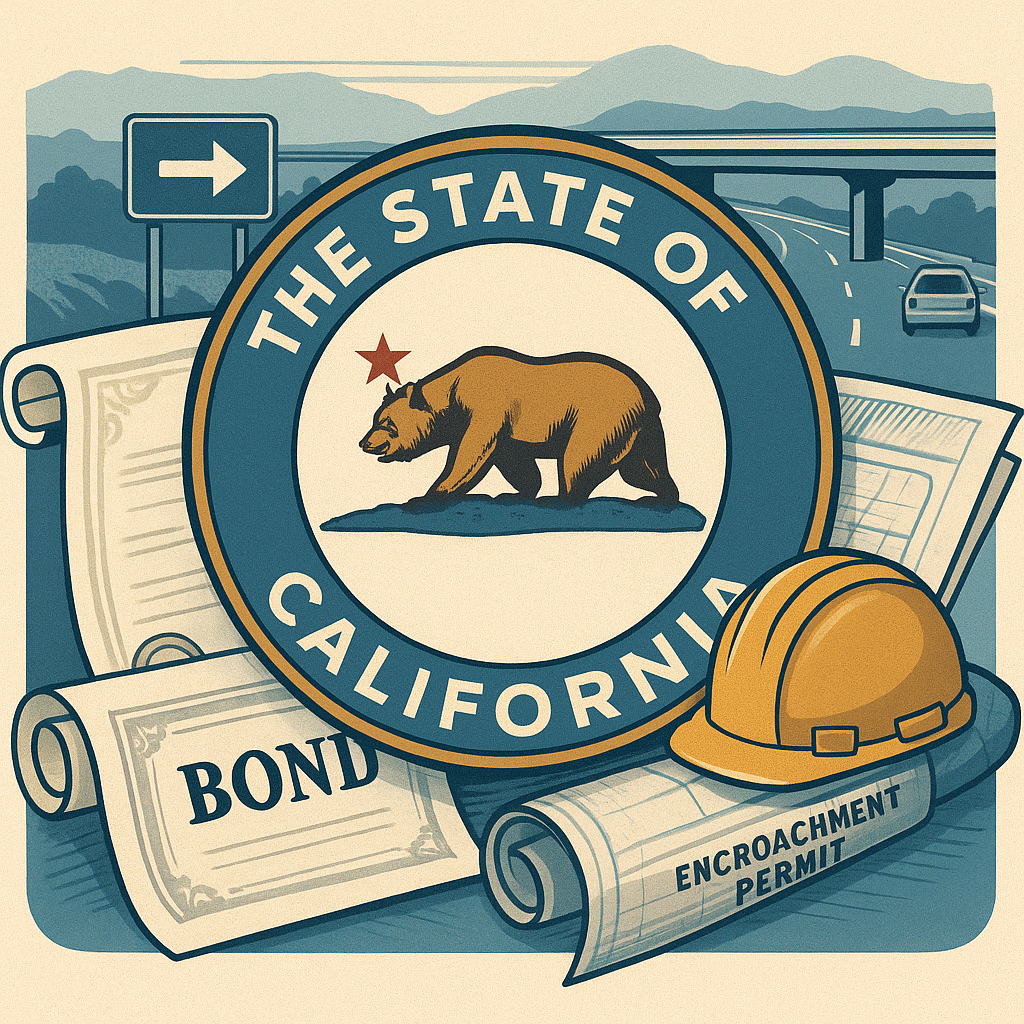
Picture this: You’re a contractor, and you just landed a project to install a new water line. The only problem? Part of that work runs right alongside a busy California state highway. Before you can even put a shovel in the ground, Caltrans hands you a list of requirements—and right near the top is something called a payment bond for a state highway encroachment permit. If that phrase makes your head spin, don’t worry. You’re not alone. Let’s break it all down in plain, everyday language.
What Exactly Is a State Highway Encroachment Permit?
An encroachment permit is essentially official permission from the California Department of Transportation—better known as Caltrans—to do work within the state highway right-of-way. Think of the right-of-way as the invisible boundaries that stretch beyond the road itself. It might include sidewalks, shoulders, drainage ditches, or the strip of land where utility poles sit.
If you or your business want to build something, dig something, plant something, or even hang a sign inside that zone, you need an encroachment permit. The state wants to make sure whatever you do doesn’t interfere with traffic, damage public property, or create safety hazards. Without one, you’re trespassing on state land—and that can get expensive fast.
Where the Payment Bond Comes Into Play
Now, permits themselves are pretty straightforward. You fill out an application, explain your project, and pay a fee. So why does Caltrans also demand a payment bond? The simple answer: to protect people you might hire.
A payment bond is a type of surety bond. It’s a financial guarantee that says, “If the permit holder doesn’t pay the subcontractors, workers, or material suppliers for the work related to this encroachment, the bond company will step in and cover those unpaid bills.” In other words, it’s a safety net that protects the little guy.
California takes this seriously because thousands of projects pop up along state highways every year—underground utilities, driveway connections, sign installations, landscaping, and more. Caltrans doesn’t want a scenario where a contractor digs up a shoulder, installs a sewer line, never pays the asphalt supplier, and disappears. The bond ensures the people who actually do the labor or provide the materials still get compensated.
How Is This Different From a Performance Bond?
This is a super common point of confusion. While a payment bond covers the bills, a performance bond covers the work itself. The performance bond guarantees the project gets done according to the permit conditions. If the contractor abandons the job halfway through, the performance bond pays to finish it. Both bonds often get lumped together in a “permit bond package,” but today we’re focusing on the payment side.
Who Needs This Bond?
The short answer: almost anyone who gets an encroachment permit for work that involves hiring subcontractors or buying significant materials. Caltrans typically requires a payment bond from:
- General contractors performing excavation, paving, or utility work within the right-of-way.
- Utility companies (gas, electric, water, telecom) running lines beneath or alongside highways.
- Developers building an access road or a driveway that connects to a state route.
- Any permit holder where the total project cost exceeds a certain threshold, or where Caltrans determines the risk of non-payment is higher.
Even a small business owner installing a sign along a state highway could be asked to post a bond, especially if they’re bringing in specialized subcontractors.
How Much Does a Payment Bond Cost?
Here’s where the math gets friendlier than you might expect. The bond amount is the maximum dollar figure the surety company will pay out if a claim arises. That amount gets set by Caltrans, often equal to the total estimated cost of the work covered by the permit. If your project is valued at $50,000, you might need a $50,000 payment bond. But you don’t pay the full face amount up front.
You pay a premium—a small percentage of the total bond. For someone with solid personal credit and a healthy business history, that premium could be as low as 1% to 3%. So a $50,000 bond might cost you only $500 per year. Applicants with lower credit scores can still usually qualify, though the premium will be a bit higher. Think of it like an insurance policy where the premium reflects the level of risk.
Can You Use a Cash Deposit Instead?
In some rare cases, Caltrans may accept a cash deposit or a letter of credit in lieu of the bond. However, that’s not the norm. Tying up tens of thousands of dollars in cash just isn’t practical for most businesses. The bond route keeps your working capital free for actual construction costs, making it the preferred choice for nearly every permit holder.
How to Get an Encroachment Permit Payment Bond
The process is a lot easier than the official name makes it sound. You’ll work with a surety company or a specialized bond broker. They’ll walk you through these typical steps:
- Confirm the requirement. Your Caltrans district office will tell you the exact bond amount needed and the required bond form—often form CEM-3703 or a similar designation.
- Apply with a surety provider. You’ll provide basic business and personal information. The underwriter reviews your credit, financial statements, and past project experience.
- Get your quote. Within a day or two, you’ll receive a premium quote. This is the only out-of-pocket cost for the bond.
- Sign and pay. Accept the quote, pay the premium, and the surety will issue the bond.
- Submit the bond to Caltrans. The original bond document goes with your permit application. Your permit won’t move forward without it.
Often, the whole thing can be wrapped up in 48 hours. Some bond agencies even offer online applications and instant quotes for smaller bonds, which can feel like a lifesaver when you’re up against a project deadline.
What Happens If You Skip the Bond?
It’s tempting to hope nobody notices. But Caltrans keeps careful records, and your permit will simply not be approved without the required bond. Even if you mistakenly begin work without a valid permit, you could face serious consequences:
- Stop-work orders that halt your entire project.
- Hefty fines that can climb into the thousands of dollars per day.
- Liability for any damage to state property, paid out of your own pocket—with no surety behind you.
- A damaged reputation that makes it harder to pull permits or win future contracts.
Put simply, skipping the bond is a gamble that never pays off.
Why Payment Bonds Benefit Everyone
Let’s step back and look at the bigger picture. You might see the payment bond as just another bureaucratic hoop to jump through. But it actually does a lot of quiet good:
For subcontractors and suppliers: They can take on a state highway project without worrying they’ll get stiffed. Laborers who pour concrete or supply guardrail materials know there’s a dedicated fund backing their invoices.
For the public: Projects stay on track. When everyone gets paid, work stays smooth, and the traveling public doesn’t have to deal with half-finished pavement or exposed utility holes.
For the permit holder: Having a bond shows Caltrans—and your own team—that you’re a serious, responsible operator. It pre-qualifies you as a reliable partner, which can lead to smoother inspections and faster paperwork.
An Analogy That Helps It Click
Think of a payment bond like a safety deposit on an apartment rental. You’re not giving the landlord the full value of the unit. You’re putting down a smaller amount—or in this case, buying a bond—that says, “If I skip out on my obligations, there’s a way to make things right.” The landlord sleeps better, and because you’ve proven you’re trustworthy, you get the keys. Caltrans is the landlord, the highway right-of-way is the apartment, and your subcontractors are the neighbors who count on you not to cause trouble.
Common Questions California Contractors Ask
Does this bond cover unpaid wages to my own company employees?
Generally, no. Payment bonds focus on subcontractors and material suppliers with direct contracts. Your in-house payroll is usually not covered. However, labor provided through a subcontractor would be. It’s always wise to review the exact bond form language.
Will one bond cover multiple permits?
Often, yes—if the same contractor is working on a series of smaller encroachments. Many California contractors arrange a “blanket” payment bond that covers all their active permits from a specific Caltrans district for the year. This can save money and paperwork. Ask your surety agent about continuous bond options.
What if someone files a false claim on my bond?
You have the right to dispute it. The surety company will investigate, and if the claim turns out to be invalid, it won’t be paid. However, you’ll want to keep meticulous records of payments, lien waivers, and signed invoices. That paperwork is your best defense.
Is a payment bond ever waived?
Small, low-risk projects might occasionally receive a waiver at the discretion of the district encampment permit engineer. But don’t count on it. Most projects worth a significant dollar amount will require the bond. When in doubt, budget for it early.
Making the Payment Bond Part of Your California Project Plan
Nobody wakes up excited to buy a surety bond. Yet understanding the payment bond for a state highway encroachment permit takes away the mystery and stress. It’s a straightforward tool that keeps California’s infrastructure work humming along fairly and securely.
By treating the bond as just another line item in your project estimate—next to concrete, safety cones, and permit fees—you avoid last-minute scrambles. You also signal to Caltrans, your crew, and your clients that you run a professional, above-board operation.
Next time you spot a crew repairing a highway shoulder or trenching near a freeway on-ramp, you’ll know there’s a silent financial agreement working behind the scenes, making sure everyone who contributed a bucket of sweat or a pallet of pipe gets paid. And if that crew is yours, you’ll already have that bond in hand.
Leave a Reply