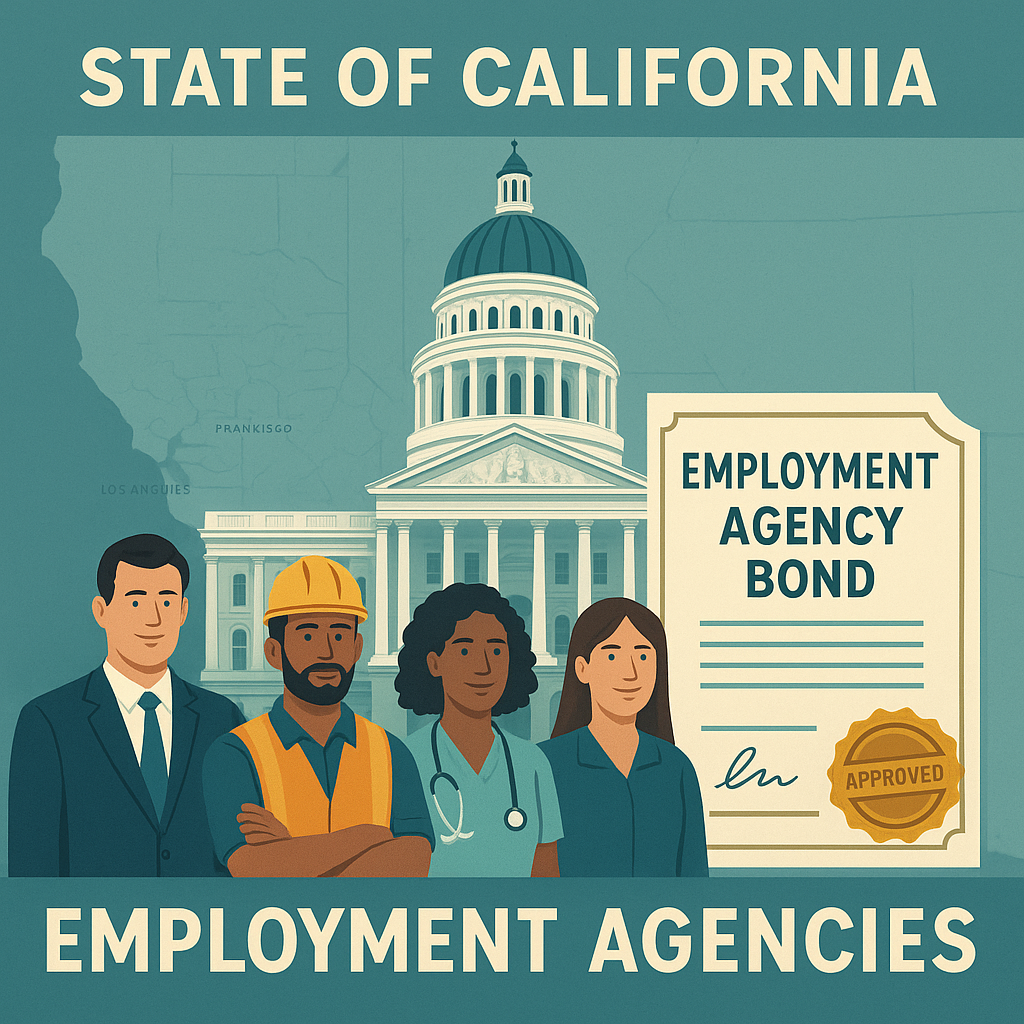
Imagine you’re looking for a new job and decide to use a staffing agency. You pay a fee, expecting them to connect you with the perfect role. But what if they take your money and disappear? Or promise a placement that never materializes? That’s exactly why the state of California requires something called an employment agency bond. It’s a safety net that protects you—the job seeker—and it’s a must-have for anyone running a hiring agency in the Golden State.
If you’re starting an employment agency or already running one, you’ve probably heard the term “CA employment agency bond” tossed around. Maybe it sounds like just another bureaucratic hoop to jump through. But it’s more than that. It’s a promise to your clients and the state that you’ll play by the rules. Let’s break it all down in simple, everyday language so you know exactly what’s required, why it matters, and how to get bonded without the headache.
What Exactly Is an Employment Agency Bond in California?
Think of an employment agency bond as a three-way handshake. On one side, you have the state of California (they’re the “obligee”). On the other side, you have your agency (the “principal”). And in the middle stands a surety company (the “surety”) that guarantees you’ll follow the law. If your agency fails to do what it promised—like not paying wages owed or engaging in deceptive practices—the bond kicks in to make things right.
It’s not insurance for your business, though. That’s a common mix-up. With insurance, you pay a premium and the insurer covers your losses if something goes wrong. A surety bond is different. If a claim is paid out, you’re on the hook to repay the surety company every penny. So it’s more like a financial guarantee that keeps your agency accountable.
In California, this bond is specifically tied to the state’s labor code. The law requires employment agencies to post a bond before they can legally operate. The standard bond amount is $10,000, though agencies with multiple locations or a history of violations might need a higher amount. It’s the state’s way of saying, “We’re giving you a license to do business, but we need a little skin in the game to protect the public.”
Who Needs This Bond and Why?
You might be wondering, “Does my business actually fall under this rule?” If you’re in the business of finding jobs for people—whether it’s temporary staffing, permanent placement, modeling agencies, nanny services, or even theatrical talent agencies in some cases—you likely need a California employment agency bond. Even online platforms that connect freelancers with gigs can fall under the definition if they charge a fee. The simplest way to check is to ask yourself: do I charge a fee to help someone find a job? If yes, keep reading.
The bond requirement isn’t just a random hurdle. It serves a crucial purpose. Back in the day, some unscrupulous agencies would collect upfront fees from hopeful job seekers, promise the world, and then vanish. Or they’d misclassify workers, fail to pay wages, or deduct illegal fees. The bond gives the state a way to recover money for victims without having to wait for a drawn-out lawsuit. It’s a real-world shield for everyday people who are just trying to earn a living.
A Quick Peek Behind the Curtain: How the Bond Protects
Let’s say you hire a nanny through an agency that promised to handle all background checks. The agency cuts corners, never runs the check, and the nanny turns out to have a troubling history. The family suffers a loss. Because the agency was bonded, the family can file a claim against that $10,000 bond. The surety investigates, and if the claim is valid, pays out up to the bond’s limit. The agency then has to repay the surety company. It’s a powerful incentive to do things right from the start.
How Much Does a California Employment Agency Bond Cost?
Here’s some good news: you don’t have to shell out $10,000 to get bonded. The premium you pay is just a small percentage of that total bond amount. For most new agencies with decent credit, you’re looking at a premium as low as $100 per year. Yes, you read that right. The bonding company looks at your personal credit, business financials, and experience. If everything checks out, you get a low rate. If your credit is a bit bumpy, the premium might be higher, but it’s still a fraction of the full bond amount.
What determines that rate? Think of it like renting a car. The rental agency trusts you with a $30,000 vehicle, but you only pay a small daily fee because they believe you’ll bring it back without a scratch. Your driving record (and credit score) influences that fee. For surety bonds, the underwriting process is similar. The surety is betting that you won’t cause a claim, and your creditworthiness is the biggest clue they have.
The Step-by-Step Process to Get Bonded
Getting your employment agency bond in California doesn’t have to be a maze. Here’s a straightforward path you can follow:
- Confirm your agency type. Double-check with the California Department of Industrial Relations or your city’s licensing office that you indeed need an employment agency bond. Requirements can vary slightly based on your exact services.
- Choose a reputable surety bond provider. You’re looking for a company that specializes in California bonds. Not all providers understand the state-specific nuances, so pick one with a track record of issuing CA employment agency bonds.
- Apply online or over the phone. The application is usually quick—basic business info, your personal details, and a consent for a credit check. You can often complete it in under ten minutes.
- Get a quote and pay the premium. Once approved, you’ll see your exact premium. Pay that, and the bond is issued instantly in most cases.
- File the bond with the state. The surety company will send you the official bond form. You (or your agent) will need to submit it to the appropriate state agency as part of your licensing package. Keep a copy for your records!
The whole process can be done in a day if you act swiftly, so there’s no need to let it stall your business launch.
Common Questions That Pop Up
“Can I get bonded with bad credit?”
Absolutely. Even if your credit isn’t stellar, you can still obtain a bond. You might pay a slightly higher premium—sometimes 5% to 15% of the bond amount instead of the standard 1%—but it’s still manageable. Think of it as a temporary cost that can improve as you build your business credit and renew year after year. Many bonding companies offer programs tailored for those with credit challenges.
“What happens if I don’t get the bond?”
Operating without a required bond is a serious no-no. The state can shut down your agency, levy fines, and even pursue legal action. Worse, if a client suffers a loss, you’d be personally liable and could face lawsuits without the bond’s structured claim process. It’s better to just cross this off your to-do list early.
“Do I need to renew the bond every year?”
Yes, employment agency bonds are usually issued with a one-year term. You’ll need to renew annually to stay compliant. The good news is that renewals are even easier than the initial application—often just a quick payment and maybe an updated check on your license status. If your credit has improved or you’ve maintained a clean claim history, your premium might even drop.
Keeping Your Bond in Good Standing
Getting the bond is one thing; keeping it is another. The best way to avoid claims is to operate your agency with transparency and integrity. This means:
- Clearly disclosing all fees to job seekers and employers before any money changes hands.
- Never promising a job placement that you can’t deliver.
- Paying temporary workers on time and in full, with proper documentation.
- Staying up to date on California labor laws, which can change. The state is known for its strong worker protections, so ignorance isn’t a defense.
- Handling client complaints swiftly before they escalate to a formal claim.
If a claim is ever filed against your bond, don’t ignore it. Work with the surety company to provide all the evidence you have. Sometimes claims are misunderstandings that can be resolved without a payout. But if the claim is valid, cooperation can reduce the financial sting and help you keep your bonding relationship for the future.
Why This Bond Is More Than Just a Piece of Paper
It’s easy to view bonds as just another expense. But try to see it from your client’s perspective. When a job seeker walks through your door, they’re often in a vulnerable spot. They might be between paychecks, anxious about their next role, and putting their trust in you. That little piece of paper—the bond—says you’ve got their back, and the state has confirmed it. It becomes a marketing advantage. You can tell clients, “We’re fully bonded and compliant with California law,” and they’ll instantly feel safer.
In a crowded marketplace, that trust can set you apart from fly-by-night agencies that skip the bonding requirement. It signals stability and professionalism. So while the bond is mandatory, it’s also a tool you can wield to build your reputation.
Tying It All Together
Navigating the world of California employment agency bonds might seem tricky at first, but it boils down to this: identify your bonding requirement, find a reliable surety partner, pay a small premium, and then focus on running a trustworthy business. The bond is there to protect the people you serve, but it also protects your business from the consequences of mistakes or misunderstandings.
If you’re ready to take the next step, start by reaching out to a bonding specialist who can walk you through the specifics for your location and agency type. The right partner will help you understand the exact paperwork, guiding you past any stumbling blocks so you can get back to what you do best: connecting talented individuals with great opportunities.
Every successful staffing agency in California started with this same requirement. Yours is no different. So embrace the process, get bonded, and build a business that stands on a foundation of trust and compliance. After all, when people know you’re held to a higher standard, they’re far more likely to choose you over the competition.
Leave a Reply