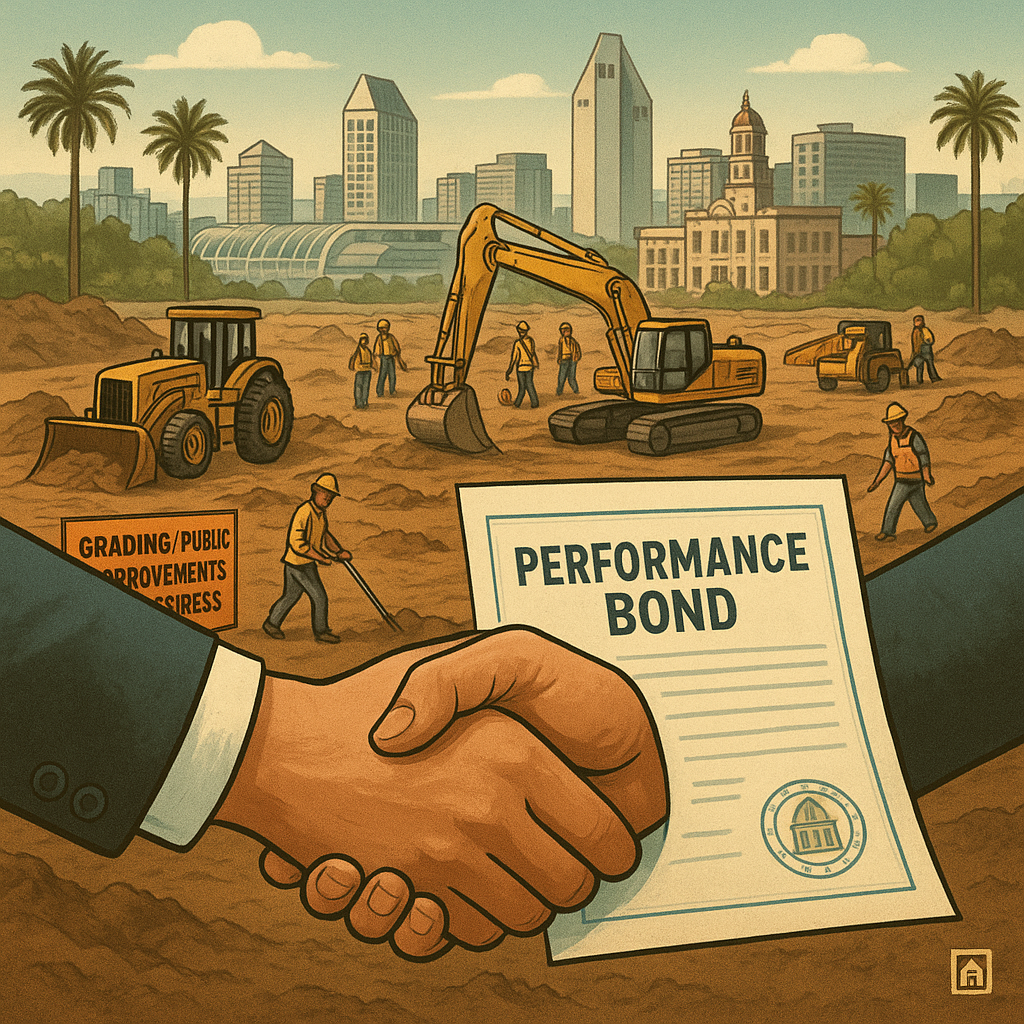
Have you ever watched a massive piece of land transform from raw dirt into a smooth, stable foundation for a new neighborhood, shopping center, or road? It’s a messy, loud, and incredibly complex job. Inside all that dust and rumbling machinery, there’s a hidden promise that everything will be done correctly. That promise is called a performance bond.
If you’re a contractor who moves earth for a living, or a developer dreaming about a new project in Southern California, you’ve probably heard the term. But what does a performance bond for grading and public improvements really mean? And why does the City of San Diego care so much about it? Let’s unpack it together in a way that makes sense, without all the legal-sounding mumbo jumbo.
What Exactly Is a Performance Bond?
Think of a performance bond as a three-way promise. It involves you, the contractor; the project owner (often a city like San Diego); and a surety company, which is a lot like an insurance company but with a very specific job. The bond guarantees that you will finish the grading or public improvement project exactly as you spelled out in your contract.
If something goes sideways — say you run out of money midway through digging a retention basin or you simply walk away from the job — the bond kicks in. The surety company steps in to either hire another contractor to finish the work, or compensate the city for the costs of getting it done. It’s a safety net for the public, and a powerful signal that you’re a serious, reliable contractor.
Grading: More Than Just Pushing Dirt
Why does grading need its own special spotlight? When you’re clearing and reshaping land, you’re doing more than just moving soil. You’re setting the stage for everything that follows. A poorly executed grading job can lead to unstable slopes, drainage nightmares, or damaged utility lines. Those aren’t just expensive fixes—they’re real safety hazards. The City of San Diego requires a performance bond because the work impacts everyone: the people who will live there, the traffic that will flow through, and the environment that surrounds it.
Why the City of San Diego Requires This Bond
Picture yourself as a city planner. You wave a green flag for a developer to build a new subdivision. The developer brings in a contractor to perform massive earthwork — cutting down slopes, filling low areas, and installing public utilities like sidewalks, curbs, and storm drains. But what if the contractor vanishes before laying the last stretch of asphalt or installing the final catch basin? The neighborhood gets stuck with a half-finished, muddy mess. Taxpayers end up footing the bill for cleanup and completion.
That’s exactly what the performance bond prevents. The City of San Diego mandates these bonds for clearing and earthwork contractors on projects that involve public improvements. The bond runs directly to the municipality, meaning the city itself is the protected party. It’s a non-negotiable part of getting your permit approved. No bond, no heavy equipment rumbling on site.
A Closer Look at “Public Improvements”
Wait, what counts as a public improvement? Here’s a quick, plain-English list:
- Streets and roads (even inside a private development if they’ll eventually become public)
- Curbs, gutters, and sidewalks
- Storm drain systems and water quality basins
- Water and sewer lines that connect to the city’s main system
- Streetlights and traffic signals
- Parks or open spaces dedicated to public use
Whenever a grading contractor touches any of these elements, the city wants assurance that the work will be completed to their strict standards. The bond is that assurance.
How a Performance Bond Protects Everyone Involved
It’s easy to think a performance bond is just another bureaucratic hoop to jump through. But when you look closer, it actually protects all sides of the table.
For the City and Its Residents
The city avoids financial disaster if a contractor fails. Taxpayer money stays safe. The bond guarantees that parks, roads, and drainage systems won’t become dangerous, unfinished scars on the landscape. It’s also a quality-control filter. Surety companies thoroughly vet contractors before issuing a bond, so only qualified, financially stable contractors get the green light.
For the Developer
Developers need to know that their contractor can finish the job on time and on budget. A performance bond gives them peace of mind and often satisfies a major requirement from their lenders or investors. It also shifts the risk away from the developer’s own balance sheet, which is a big deal in the fast-paced world of construction finance.
For the Contractor
At first glance, obtaining a bond might feel like an extra expense. But being bondable is a badge of honor. It tells cities, developers, and competitors that you’ve been tested, you have solid credit, a history of successful projects, and the working capital to handle large-scale earthwork. It opens the door to bigger, more profitable public works contracts that non-bondable contractors can’t touch.
Walking Through the Bonding Process for a San Diego Project
So how do you actually secure a performance bond for a grading or public improvement job in San Diego? Let’s break it down into simple steps.
Step 1: Start Early. Don’t wait until the day before your permit application deadline. The surety company needs time to review your company’s financial health, experience, and project details. Rushing is the quickest way to hit a wall.
Step 2: Find a Good Surety Agent. Look for someone who specializes in construction bonds, not just general insurance. They’ll understand the unique requirements of earthwork, the San Diego region’s soils and hillsides, and the city’s specific bonding forms.
Step 3: Get Your Paperwork in Order. Be ready to share company financial statements, a detailed work history, project contracts, and sometimes personal financial information for the owners. The surety will assess your capability to handle the job. Think of it like applying for a very large loan — except the surety is lending its reputation and financial backing, not cash.
Step 4: Underwriting and Approval. The surety evaluates the risk. How complex is the grading? What’s the soil condition? How long is the project timeline? They’ll then set a premium, which is a percentage of the total contract value. For well-qualified contractors, this is usually a manageable cost—somewhere between 0.5% and 3% of the contract amount.
Step 5: Submit the Bond to the City. Once approved, the surety issues the bond form, ready to be filed with the City of San Diego’s development services department alongside your permit application. The bond runs to the municipality by name — a specific requirement you must double-check to avoid rejection.
Common Questions Contractors Ask
Let’s tackle a few head-scratchers that pop up again and again.
“Is a Performance Bond the Same as Liability Insurance?”
No, and mixing them up can cause big headaches. Insurance protects against accidents and unforeseen events — a sudden gas line strike or an injury on site. It pays for damages after something bad happens. A performance bond, on the other hand, guarantees that the work itself gets finished. It’s about fulfilling promises, not just covering mishaps. You’ll likely need both for a city earthwork project.
“What if the Project Changes After We Start?”
Grading projects rarely unfold exactly as planned. If the scope of work changes significantly, you may need to amend or increase the bond amount. Always keep your surety agent in the loop about major change orders. A bond that doesn’t match the real scope of work could leave you exposed.
“How Long Does the Bond Last?”
The bond remains in effect until the City of San Diego formally accepts the completed improvements. That means after the final inspection, the filing of lien releases, and often a maintenance period (sometimes called a warranty period). Don’t expect a quick release the day the last paver is set. City engineers need time to ensure everything settles correctly and performs as designed through a rainy season or two.
Lessons from the Field: A Real-World Analogy
Imagine you hire a wedding planner for an outdoor ceremony on a newly landscaped hillside. The planner promises to flatten the ground, lay down a perfect lawn, and build a small bridge over a creek. You pay a deposit, but halfway through, they disappear with the money, leaving a half-built slope and a pile of lumber. Without a performance bond, you’re stuck scrambling to find someone else, paying twice, and maybe missing your own wedding date. With a bond, the surety company would have hired a new crew and made sure the ceremony site was ready, without costing you an extra dime. That’s the same promise a grading contractor’s bond makes to a community — the park, the road, or the flood-control channel will be delivered as promised.
Why This Matters for San Diego’s Future
San Diego is growing, and with growth comes the constant hum of grading equipment. From master-planned communities in Otay Ranch to infill projects in North Park, earthwork shapes how we live. The performance bond requirement is a quiet guardrail that keeps quality high and risk low. It ensures that a contractor’s financial trouble doesn’t become a neighborhood’s burden.
For contractors, understanding and embracing this bond isn’t just about checking a box. It’s about demonstrating you’re a stable, trustworthy partner in building the region’s infrastructure. It elevates your business and opens doors to the kind of work that defines a skyline and a community.
So next time you drive past a sprawling grading site, remember the invisible promise sealed on paper miles away. That bond is more than a piece of bureaucracy—it’s the foundation of trust that lets our city grow safely, one load of dirt at a time.
Leave a Reply