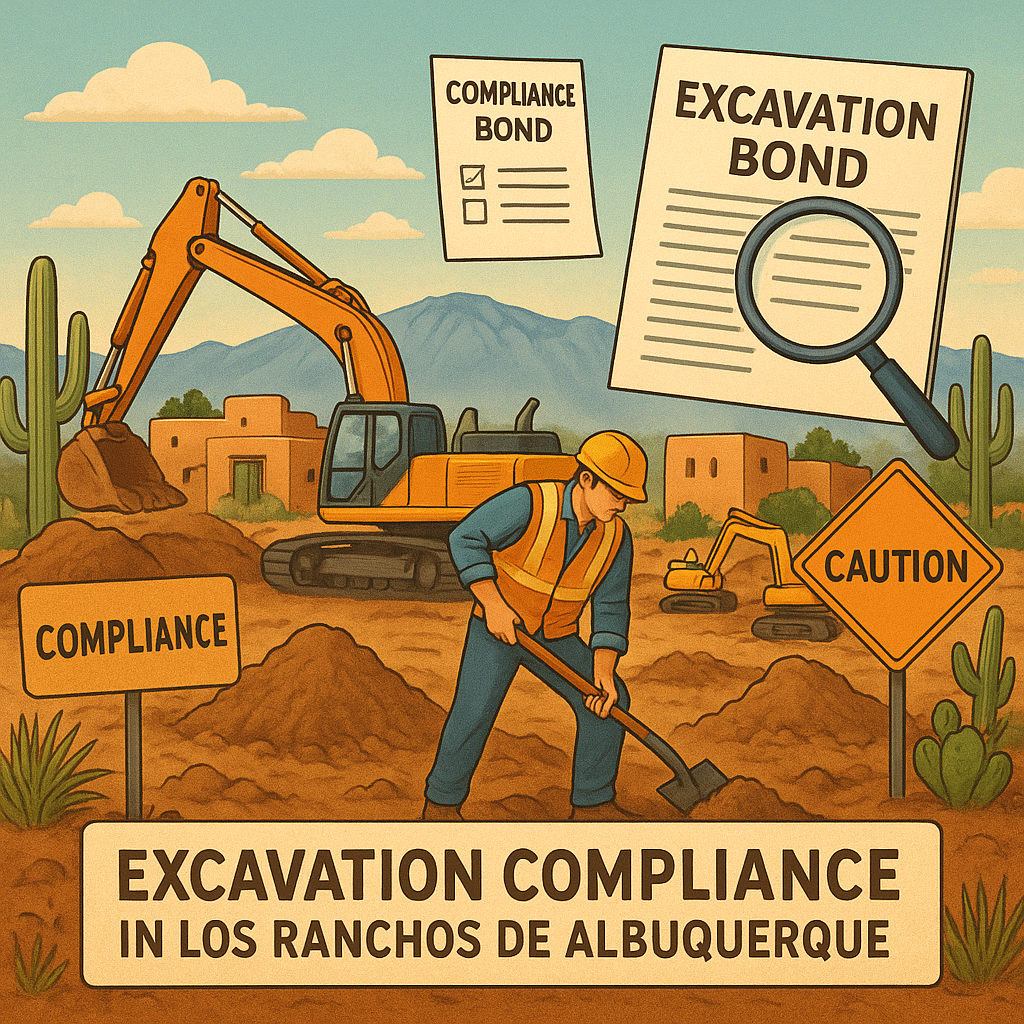
If you’re planning to dig into the earth in Los Ranchos de Albuquerque—whether to install a new water line, build a foundation, or trench for utilities—you’ve probably come across the term “excavation bond.” It might sound like just another piece of red tape, but in reality, it’s a promise. A promise to the community that you’ll leave the land as you found it, or better. Let’s unpack what that means in plain, everyday language.
What Exactly Is an Excavation Contractor’s Bond?
Think of an excavation bond as a financial handshake between you, the contractor, and the Village of Los Ranchos de Albuquerque. It’s a form of insurance, but not the kind that covers your tools or your truck. Instead, a compliance bond guarantees that you will follow all local rules when you dig. If you don’t, the village can use that bond money to fix any damage you caused.
In the simplest terms: you pay a small premium to a surety company, and they promise the village a larger sum of money. You’re still responsible for your work, but this bond gives the local government a safety net. It’s like when you rent a hotel room and they put a hold on your credit card for incidentals. The money isn’t gone, but it’s there if something goes wrong.
Why Los Ranchos de Albuquerque Requires a Compliance Bond
Los Ranchos de Albuquerque is a unique village nestled along the Rio Grande. It’s known for its agricultural roots, acequias, and quiet, tree-lined neighborhoods. With that comes a deep responsibility to protect public infrastructure such as roads, sidewalks, drainage systems, and utility lines. When an excavation contractor breaks ground, the risk of accidentally hitting a gas line or causing a sinkhole is real.
That’s why the Village of Los Ranchos de Albuquerque wants every excavation contractor to be bonded. The “Compliance Only” designation means the bond isn’t about the quality of your final building—it’s strictly about following the rules during the digging phase. You’re promising to comply with the village’s excavation ordinances, from how deep you go to how you clean up the site afterwards.
What Does “Compliance Only” Really Mean?
Some bonds guarantee that an entire project will be finished to perfection. That’s a performance bond. An excavation compliance bond, on the other hand, is narrower. It only covers the earthwork. Did you backfill the trench properly? Did you compact the soil so the road doesn’t buckle next year? Did you restore the landscaping? That’s compliance. The village isn’t judging your electrical work or your carpentry—just the hole you made and what you did to make it whole again.
Who Needs This Bond?
If you’re an excavation contractor working on public or private property within the Village of Los Ranchos de Albuquerque, you’ll very likely need this bond before you can pull a permit. It’s not just for the big construction companies. Even a small landscaping crew that needs to trench for a sprinkler system may fall under these rules. When in doubt, call the village planning or public works department. They’re surprisingly friendly and can tell you exactly what’s required for your specific project.
A Real-World Example
Imagine you’re hired to connect a new house to the village sewer line. You dig up a section of the street, careful but hurried. The work gets done, you cover the hole, and you drive away. Months later, the asphalt sinks six inches. That’s a classic compliance failure. Without a bond, the homeowner or the village is stuck with the repair bill. With a bond in place, the village makes a claim, the surety pays for the fix, and then the surety comes to you for reimbursement. It keeps everyone honest.
How to Obtain Your Excavation Bond in Los Ranchos de Albuquerque
Getting bonded is simpler than you might think. The process usually involves reaching out to a licensed surety bond agency that writes bonds in New Mexico. You’ll need your contractor’s license information and some basic details about your business. The agent will quote you a premium based on the bond amount required by the village. For a compliance-only excavation bond, the amount is typically set by the village—often a few thousand dollars—and your premium might be as low as $100 to $300 a year, depending on your credit and financial history.
Why is the premium so small? Because the bond amount itself is usually modest, and the risk is fairly low for the surety company. They believe in you, but they also want to see that you have a clean record and know what you’re doing.
Once the bond is issued, you’ll present it to the Village of Los Ranchos de Albuquerque along with your permit application. Keep a copy for your records. It’s that straightforward.
Common Mistakes That Can Lead to a Claim
Nobody wants a bond claim. It’s a headache for everyone. But knowing what trips people up can save you from costly mistakes. Here are the most frequent missteps:
- Incomplete backfilling: Using the wrong soil or failing to compact it in layers. This leads to settling and potholes.
- Damaging an unmarked utility: Good practice calls for calling 811 before you dig. Forgetting this step can rupture a water main and trigger a claim.
- Ignoring drainage patterns: Changing the natural flow of stormwater can flood a neighbor’s yard. The village watches for this closely.
- Leaving the site a mess: Compliance isn’t just under the ground. It includes removing debris, regrading, and sometimes even replanting grass or shrubs.
- Working without a permit: Operating under the radar is the fastest way to void your bond protection entirely.
The Cost of an Excavation Bond and What Affects It
As we touched on earlier, the cost is manageable for most contractors. But you might be wondering what goes into that price. The surety bond company looks at your personal credit score, your business financials, and your experience. If you’ve had claims in the past, your premium could go up. If you’re new to the game with no track record, you might pay a slightly higher percentage until you prove yourself.
Still, don’t let fear of cost keep you from getting bonded. Many contractors find that having the bond actually gives them a competitive advantage. Homeowners and developers in Los Ranchos de Albuquerque often prefer to hire bonded excavators because it shows you’re professional and you stand behind your work.
Is the Bond Amount a One-Time Fee?
No. A compliance bond is typically an annual obligation. You’ll need to renew it each year you plan to work in the village. Some agencies offer multi-year options, which can save you a bit of money and paperwork. Mark your calendar so you don’t let it lapse—doing so can stall your next project.
Benefits That Go Beyond the Village Hall
Obeying the rules isn’t just about avoiding fines. When you hold a valid excavation bond in Los Ranchos de Albuquerque, you’re telling the world—and your customers—that you care about doing things the right way. It builds trust. Imagine a homeowner comparing two bids. One contractor says, “I’m bonded and insured,” and the other shrugs. Who would you hire? Probably the one that gave you peace of mind.
A bond also protects your own business. Instead of a lawsuit dragging on for months, a claim can be resolved more quickly through the bond process, and your reputation recovers faster if you cooperate with the surety. It’s a buffer between you and the unexpected.
What Happens If a Claim Is Filed Against You?
Let’s walk through that scary moment. The village inspector notices a problem—maybe a depressed roadway above your old trench. They notify you. You have a chance to fix it. Most issues are resolved at this friendly stage. But if you refuse or disappear, the village files a claim with the surety. The surety investigates. If the claim is valid, they pay the repair cost up to the bond amount. Then they come to you for reimbursement. Yes, you have to pay them back. The bond is not free money; it’s a line of credit that you ultimately cover.
That’s why honest, prompt communication with the village is your best defense. Fix small problems before they become big, expensive claims.
Frequently Asked Questions from Local Contractors
Here are a few common questions we hear from people navigating the excavation bond process in Los Ranchos de Albuquerque, NM:
Q: Can I use the same bond for multiple jobs in the village?
A: Generally, yes—if it’s a blanket bond covering all your work within a certain period. Some bonds are project‑specific, though, so clarify that with your bond agent.
Q: How long does it take to get bonded?
A: Often the same day, if you have your paperwork ready. Simple excavation bonds are quick to underwrite.
Q: Does my general liability insurance cover the same things?
A: Not exactly. Liability insurance might cover bodily injury or property damage from an accident, but it won’t guarantee compliance with village excavation codes. The bond fills that gap.
Q: Is this bond required just for public property, or for private land too?
A: Even on private land, if your excavation could affect village rights-of-way, utility easements, or public infrastructure, a bond may be required. Always ask.
Partnering with the Village for a Smoother Project
The Village of Los Ranchos de Albuquerque puts these rules in place not to make your life difficult, but to protect the character and safety of the community. When every excavation contractor follows the same standards, the roads stay smooth, the acequias flow as they should, and neighbors’ properties aren’t flooded by careless grading. By getting your compliance bond and playing by the rules, you become part of that positive cycle.
Before you start your next excavation project, take a few minutes to confirm the current bond requirements with the village clerk or building official. Regulations can change, and you want the most accurate information. Then, talk to a trusted New Mexico surety bond provider who understands the unique needs of Los Ranchos. They’ll help you cross the t’s and dot the i’s.
Remember, a compliance bond isn’t just a piece of paper. It’s your ticket to earning respect, winning more bids, and sleeping soundly knowing that your work is protected. Dig safe, dig smart, and keep Los Ranchos de Albuquerque the beautiful place it is.
Leave a Reply